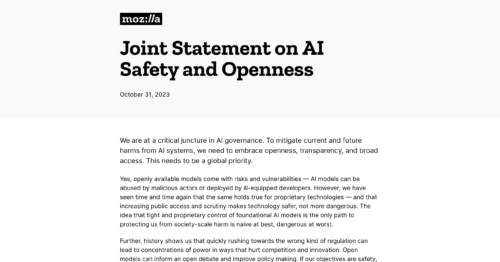
CDT Joins Expert Letter on AI Openness and Security During UK AI Safety Summit
CDT CEO Alexandra Reeve Givens today signed a joint letter with a broad range of other AI technology and policy experts from industry and civil society, in the context of the UK AI Safety Summit that Givens is attending. The same letter was signed by CDT AI Governance Lab advisory committee members Deborah Raji and Irene Solaiman.
The letter – organized by Mozilla – highlights the important role that open source software and open science can play in helping ensure a future AI ecosystem that is more transparent, accountable, secure, and competitive. It comes at a time when some policymakers are urging novel new restrictions on the ability to openly publish powerful AI new models.
As the letter concludes, “we are a diverse group — scientists, policymakers, engineers, activists, entrepreneurs, educators and journalists. We represent different, and sometimes divergent, perspectives, including different views on how open source AI should be managed and released. However, there is one thing we strongly agree on: open, responsible and transparent approaches will be critical to keeping us safe and secure in the AI era.”
Coalition Urges Senate Not to Let Companies Waive Financial Regulations for AI
CDT joined AI Now Institute, American Civil Liberties Union, and several organizations dedicated to tech policy, consumer protection, and civil rights in a letter to Senate leadership and the Senate Banking, Housing, and Urban Affairs Committee opposing the “AI Innovation Labs” language in Sec. 10509 of the CLARITY Act.
As concern about risks and harms related to AI systems continue to grow, a growing chorus of policymakers, industry leaders, and advocates have called for independent AI assessments. This explainer provides an overview of recent proposals for third-party assessment in the United States, including state and federal legislation, executive actions, and industry proposals.
Having third parties assess AI systems might seem like common sense, but crafting effective policies toward this goal can be devilishly tricky. A poorly-constructed ecosystem for third-party assessment could easily fail to consider the most consequential mechanisms of risk, neglect the AI harms that most impact people, or do more to protect AI companies than people.
Not All Guardrails Are Created Equal: Comparing Content Safety and Copyright Filtering
As courts and policymakers work through questions about chatbot liability, they should be wary of analogies that flatten meaningful technical differences. Copyright filtering and safety intervention share real challenges around ambiguity and evasion, but they diverge in what each control must assess, how each manifests over the course of a conversation, and how much can be verified from the outside.