New CDT Newsletter for Journalists Highlights Emerging Internet Infrastructure Issues
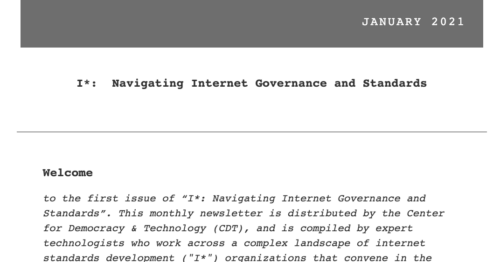
With the aim of helping reporters and others understand the latest internet infrastructure issues, I’m working with fellow public interest technologists — people involved in the process of setting the protocol standards for the internet — to release a monthly newsletter. Our hope is to help the public and policymakers understand how the internet might be governed.
The ways in which people experience the internet, and the accompanying civil and human rights concerns, are fundamentally informed by its core infrastructure. However, the internet’s ongoing development, implementation, and maintenance remain practically invisible to the broader public.
Instead, debates about these technical problems take place within a narrow and complex landscape of internet standards development organizations that convene experts in the public interest.
Understanding the issues that arise in these conversations — such as net neutrality and the architecture tradeoffs between user privacy and network security — can help provide a fuller picture of technology’s role in societies around the world.
We’re calling the newsletter I*: Navigating Internet Governance and Standards. It will highlight emerging issues and clearly explain their technical underpinnings for a non-technical audience.
It will also provide brief and clear expert insight into trusted and curated source material, focusing on the current privacy and free expression controversies within several “I-star” standards-setting organizations — namely, the Internet Corporation for Assigned Names and Numbers (ICANN), the Internet Engineering Task Force (IETF), the Institute of Electrical and Electronics Engineers (IEEE), and the International Telecommunication Union (ITU).
From the systems that determine routes for sending and receiving data across the internet and the new internet protocols containing “killswitches” that could have dramatic implications for free expression, to the rollout of end-to-end encryption for messaging services and the antitrust implications of placement in search results, public interest technology issues have an impact on every user of the internet around the world.
CDT has a long history in the internet governance arena. In 2000, we started the Internet Standards, Technology & Policy Project with the goals of driving public interest involvement in key internet standards-setting bodies, and making technical resources available to policymakers and advocates. Since then, we have continuously engaged in internet standards debates over issues like the IANA transition and privacy safeguards for location information.
We look forward to sharing with you the things technologists working in the public interest are thinking about, and why they’re important!
On September 15, 2026, the Center for Democracy & Technology and Electronic Frontier Foundation filed an amicus brief along with the Wikimedia Foundation in Meta Platforms v. Bonta, challenging California’s SB 976.
Coalition Urges Senate Not to Let Companies Waive Financial Regulations for AI
CDT joined AI Now Institute, American Civil Liberties Union, and several organizations dedicated to tech policy, consumer protection, and civil rights in a letter to Senate leadership and the Senate Banking, Housing, and Urban Affairs Committee opposing the “AI Innovation Labs” language in Sec. 10509 of the CLARITY Act.
Not All Guardrails Are Created Equal: Comparing Content Safety and Copyright Filtering
As courts and policymakers work through questions about chatbot liability, they should be wary of analogies that flatten meaningful technical differences. Copyright filtering and safety intervention share real challenges around ambiguity and evasion, but they diverge in what each control must assess, how each manifests over the course of a conversation, and how much can be verified from the outside.
Potential Avenues for Redress for AI-related Harms under EU Equality and Non-Discrimination law: A Visual Explanation
In this third instalment of the series, we look at the opportunities afforded by EU equality and non-discrimination law in providing redress for AI-related harms.