CDT Joins Open Letter Urging Facebook to Extend Journalist- and Politician-Protections to Elections Workers in Georgia
This week, the Center for Democracy & Technology joined a coalition of nearly 60 progressive groups in signing an open letter, organized by UltraViolet Action and Color of Change, urging Facebook to stop the harassment of and violent threats against poll workers and other elections officials leading up to Georgia’s runoff Senate election on January 5th, 2021.
As part of that work, it is imperative to extend to elections workers the same protections currently provided to journalists and politicians, in addition to taking broader steps to block the spread of disinformation and violence in Georgia.
***
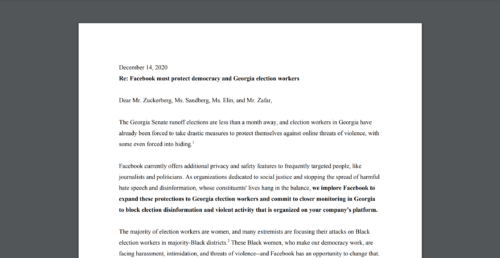
December 14, 2020 Re: Facebook must protect democracy and Georgia election workers Dear Mr. Zuckerberg, Ms. Sandberg, Ms. Elin, and Mr. Zafar,
The Georgia Senate runoff elections are less than a month away, and election workers in Georgia have already been forced to take drastic measures to protect themselves against online threats of violence, with some even forced into hiding.
Facebook currently offers additional privacy and safety features to frequently targeted people, like journalists and politicians. As organizations dedicated to social justice and stopping the spread of harmful hate speech and disinformation, whose constituents’ lives hang in the balance, we implore Facebook to expand these protections to Georgia election workers and commit to closer monitoring in Georgia to block election disinformation and violent activity that is organized on your company’s platform.
The majority of election workers are women, and many extremists are focusing their attacks on Black election workers in majority-Black districts. These Black women, who make our democracy work, are facing harassment, intimidation, and threats of violence–and Facebook has an opportunity to change that.
This is not a partisan issue; it’s a matter of protecting our public servants and the integrity of our democracy. Election workers across Georgia are reporting widespread harassment and death threats,–one worker found a noose outside of his family’s home with his name on it. On December 1, Republican Gabriel Sterling, Georgia’s voting system implementation manager, warned at a press conference that “[s]omeone is gonna get hurt, someone is gonna get shot, someone is gonna get killed.” He added, “It’s not right.”
Facebook has served as a site for hateful extremists to spread disinformation, harass election workers, and undermine our votes. Now, heading into the final weeks of the runoff elections, it’s critical that Facebook take immediate action to protect Georgia election workers by extending to them the protections that are currently provided to journalists and politicians and taking steps to block the spread of disinformation and violence in Georgia.
Not All Guardrails Are Created Equal: Comparing Content Safety and Copyright Filtering
As courts and policymakers work through questions about chatbot liability, they should be wary of analogies that flatten meaningful technical differences. Copyright filtering and safety intervention share real challenges around ambiguity and evasion, but they diverge in what each control must assess, how each manifests over the course of a conversation, and how much can be verified from the outside.
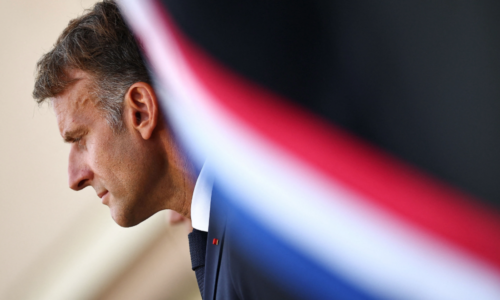
Op-Ed: France’s Constitutional Council Ruling Tests the Limits of Social Media Bans
Read our analysis the legal and policy significance of the Constitutional Council’s decision on ongoing social media age restriction and age assurance debates ahead of the most-anticipated EU-wide approach on child online safety due by December 2026.
The brief explains that Section 230’s liability protections are essential to enable free expression online and they extend to the use of automated systems to engage to rank and order content as part of traditional publishing activities.