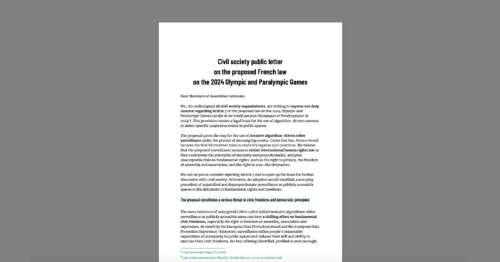
CDT Joins Letter on the Proposed French Law on the 2024 Olympic and Paralympic Games
The Centre for Democracy & Technology Europe (CDT Europe) joined an open letter led by the European Center for not for Profit Law, La Quadrature du Net and Amnesty International France, alongside 37 civil society organisations expressing concerns regarding Article 7 of the proposed law on the 2024 Olympic and Paralympic Games (projet de loi relatif aux jeux Olympiques et Paralympiques de 2024), which would create a legal basis for the use of algorithm-driven cameras to detect specific suspicious events in public spaces. The letter calls on the Assemblée Nationale to consider rejecting Article 7 and to open up the issue for further discussion with civil society.
From the letter:
“The mere existence of untargeted (often called indiscriminate) algorithmic video surveillance in publicly accessible areas can have a chilling effect on fundamental civic freedoms, especially the right to freedom of assembly, association and expression. As noted by the European Data Protection Board and the European Data Protection Supervisor, biometric surveillance stifles people’s reasonable expectation of anonymity in public spaces and reduces their will and ability to exercise their civic freedoms, for fear of being identified, profiled or even wrongly prosecuted. As such, this measure threatens the very essence of the right to privacy and data protection, which is incompatible with international and European human rights law”.
British Public Oppose Secret Surveillance Powers and Want Strong Protections for Encrypted Communications
CDT released nationally representative polling data revealing that a the British public are broadly concerned about the security, privacy, and free speech consequences of allowing law enforcement to access encrypted communications.
Responding to the EU-US Negotiations on Reciprocal Data Exchanges for Border Procedures
CDT Europe, together with 29 other civil society organisations and academics, sent an open joint letter to the Council of the EU regarding the worrying direction taken by the European Commission in the EU-US border negotiations with the U.S. government.
Open Joint Letter on a Public Reassessment of the EU-US Adequacy Decision
On 29 June, the US Supreme Court ruled that US President Trump can remove the leaders of independent agencies and commissions, overturning nearly 90 years of precedent limiting executive power. This decision raises serious questions about one of the key safeguards underpinning the EU-US Data Privacy Framework adopted in 2023: independent supervision.
Return of Mass Scanning of Private Communications through Undemocratic Procedure
CDT Europe responds to the European Parliament's vote to revive the interim derogation from the ePrivacy Directive, commonly known as “Chat Control 1.0”, which provides the legal basis for the voluntary, indiscriminate scanning of private communications for known and new Child Sexual Abuse Material (CSAM), and for the solicitation of children.