The bipartisan act unanimously passed the House earlier this year, and would protect journalists from surveillance or compelled disclosure of source materials except in emergency situations.
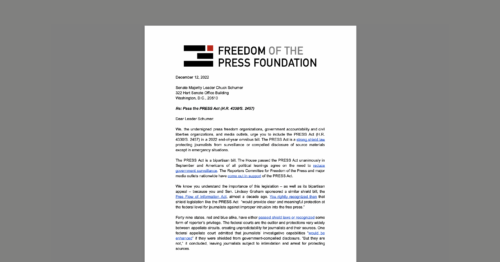
The coalition letter follows a separate letter from the Reporters Committee for Freedom of the Press on behalf of 15 major news organizations including The New York Times, The Washington Post, NPR and CNN.
From the letter:
****
Forty nine states, red and blue alike, have either passed shield laws or recognized some form of reporter’s privilege. The federal courts are the outlier and protections vary widely between appellate circuits, creating unpredictability for journalists and their sources. One federal appellate court admitted that journalists’ investigative capabilities “would be enhanced” if they were shielded from government-compelled disclosure. “But they are not,” it concluded, leaving journalists subject to intimidation and arrest for protecting sources.
…
The Fourth Estate is not free as long as prosecutors and investigators are empowered to commandeer newsrooms in disregard of the media’s constitutionally-recognized independence.
It is crucial that you act before this Congress adjourns so that journalists do not need to wait another decade or more for the protections they need to do their jobs effectively. By reaffirming your longtime commitment to First Amendment freedoms, you will be sending a powerful message to journalists and all Americans who rely on a free and vibrant press to participate in democracy.”
Not All Guardrails Are Created Equal: Comparing Content Safety and Copyright Filtering
As courts and policymakers work through questions about chatbot liability, they should be wary of analogies that flatten meaningful technical differences. Copyright filtering and safety intervention share real challenges around ambiguity and evasion, but they diverge in what each control must assess, how each manifests over the course of a conversation, and how much can be verified from the outside.
CDT-led Coalition Calls for Transparency for White House AI Framework
CDT and Americans for Responsible Innovation led a broad, bipartisan coalition of over two dozen civil society groups in calling on the White House to release its Framework for review of frontier AI models.
CDT Amicus Brief Calls on Fourth Circuit to Rein In Geofence Warrants
Earlier this year the Supreme Court ruled in Chatrie v United States that the Fourth Amendment protected all cell phone location information, which CDT lauded as a landmark decision, but sent the case back down to the Fourth Circuit to assess the propriety of the geofence warrant at issue.
CDT and Partners Post Floor Alert Opposing CA SB 1013 Automated License Plate Readers Bill
The best way to ensure that Automated License Plate Readers are not abused is to limit the retention of stored data and to keep loopholes to lawful process closed. CA SB 1013 is a step in the wrong direction, and we urge the California legislature to reject this approach.