CDT Joins 45+ Orgs in Letter Urging Congress to Protect Americans’ Privacy and Bring American Data Privacy and Protection Act to Vote
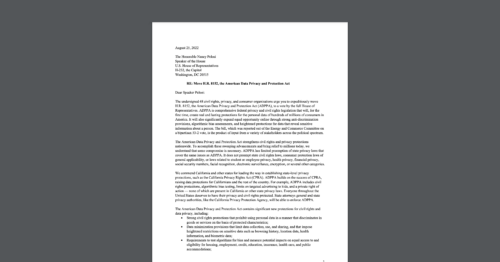
The Center for Democracy and Technology (CDT) joined over 45 other civil society organizations in a letter calling on Speaker Pelosi to bring the American Data Privacy and Protection Act (ADPPA) to a vote on the House floor as soon as possible.
The ADPPA is a bipartisan, compromise bill that, while not perfect, represents a reasonable compromise on both sides to finally bring consumers privacy protections they’ve long wanted, including strong civil rights protections, privacy protections that are the responsibility of companies, and more.
***
From the letter:
The undersigned 48 civil rights, privacy, and consumer organizations urge you to expeditiously move H.R. 8152, the American Data Privacy and Protection Act (ADPPA), to a vote by the full House of Representatives. ADPPA is comprehensive federal privacy and civil rights legislation that will, for the first time, create real and lasting protections for the personal data of hundreds of millions of consumers in America. It will also significantly expand equal opportunity online through strong anti-discrimination provisions, algorithmic bias assessments, and heightened protections for data that reveal sensitive information about a person. The bill, which was reported out of the Energy and Commerce Committee on a bipartisan 53-2 vote, is the product of input from a variety of stakeholders across the political spectrum.
CDT and Partners Urge Passage of the California Location Privacy Act of 2025 (AB 322)
Location data is particularly sensitive, and when collected across time it can reveal a broad range of intrusive insights such as medical conditions, sexual orientation, political activities, and religious beliefs.
CDT and Allies Urge FCC Not to Violate Privacy of Cell Phone Buyers
CDT and EPIC led a coalition of 15 organizations in urging the FCC not to require phone companies to collect government IDs, physical addresses, and alternate phone numbers from every phone subscriber in the country.
As Brussels starts emptying for the summer, the risks of frontier AI models continue to capture the attention of policymakers as a key chapter of the AI Act becomes enforceable, and disclosure rules around the use of AI systems and AI-generated content are further clarified.