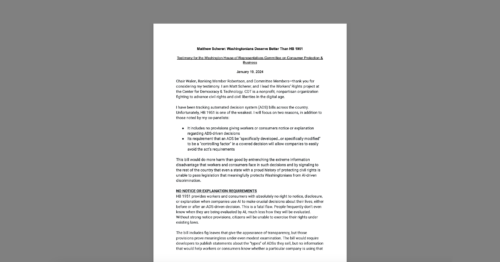
CDT’s Matthew Scherer Testifies Before Washington House of Representatives in Opposition to Bill That Would Establish Weak Standards for Workplace Technology Regulations
The Center for Democracy & Technology (CDT) has been tracking efforts across the country to regulate automated employment decision systems (AEDS) and electronic management and automated management (ESAM) systems.
Last week, the Washington House of Representatives’ Committee on Consumer Protection and Business held a hearing on House Bill 1951, which seeks to regulate AEDS and ESAM as well as automated decision-making in a number of other contexts, such as housing, credit, and criminal justice.
On January 19, 2024, CDT’s Senior Policy Counsel Matthew Scherer testified in opposition to it, primarily due to its narrow definition of automated decision-making as well as its complete lack of notice, disclosure, explanation, and other transparency provisions.
Due to those weaknesses, described in greater detail in the written testimony linked below, HB 1951 would do more harm than good by entrenching and blessing the extreme information disadvantage that workers and consumers face when companies use AI to make crucial decisions about their lives.
CDT and Partners Urge Passage of the California Location Privacy Act of 2025 (AB 322)
Location data is particularly sensitive, and when collected across time it can reveal a broad range of intrusive insights such as medical conditions, sexual orientation, political activities, and religious beliefs.
CDT and Allies Urge FCC Not to Violate Privacy of Cell Phone Buyers
CDT and EPIC led a coalition of 15 organizations in urging the FCC not to require phone companies to collect government IDs, physical addresses, and alternate phone numbers from every phone subscriber in the country.
As Brussels starts emptying for the summer, the risks of frontier AI models continue to capture the attention of policymakers as a key chapter of the AI Act becomes enforceable, and disclosure rules around the use of AI systems and AI-generated content are further clarified.