CDT Weighs In on Meta Oversight Board’s case on Takedown of Speech Calling for Attack on Brazil’s National Congress
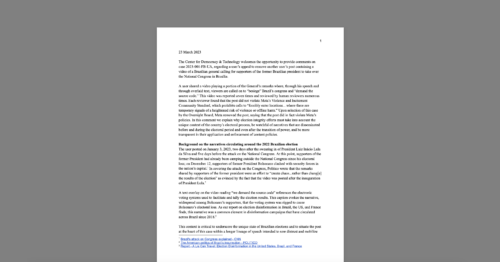
The Center for Democracy & Technology (CDT) welcomes the opportunity to provide comments on case 2023-001-FB-UA before the Meta Oversight Board, regarding a user’s appeal to remove another user’s post containing a video of a Brazilian general calling for supporters of the former Brazilian president to take over the National Congress in Brasília.
A user shared a video playing a portion of the General’s remarks where, through his speech and through overlaid text, viewers are called on to “besiege” Brazil’s congress and “demand the source code.” This video was reported seven times and reviewed by human reviewers numerous times. Each reviewer found that the post did not violate Meta’s Violence and Incitement Community Standard, which prohibits calls to “forcibly enter locations…where there are temporary signals of a heightened risk of violence or offline harm.” Upon selection of this case by the Oversight Board, Meta removed the post, saying that the post did in fact violate Meta’s policies.
In this comment, we explain why election integrity efforts must take into account the unique context of the country’s electoral process, be watchful of narratives that are disseminated before and during the electoral period and even after the transition of power, and be more transparent in their application and enforcement of content policies.
Not All Guardrails Are Created Equal: Comparing Content Safety and Copyright Filtering
As courts and policymakers work through questions about chatbot liability, they should be wary of analogies that flatten meaningful technical differences. Copyright filtering and safety intervention share real challenges around ambiguity and evasion, but they diverge in what each control must assess, how each manifests over the course of a conversation, and how much can be verified from the outside.
Op-Ed: France’s Constitutional Council Ruling Tests the Limits of Social Media Bans
Read our analysis the legal and policy significance of the Constitutional Council’s decision on ongoing social media age restriction and age assurance debates ahead of the most-anticipated EU-wide approach on child online safety due by December 2026.
The brief explains that Section 230’s liability protections are essential to enable free expression online and they extend to the use of automated systems to engage to rank and order content as part of traditional publishing activities.