CDT Joins Coalition Letter Calling Out Serious Concerns With “No Section 230 Immunity for AI Act”
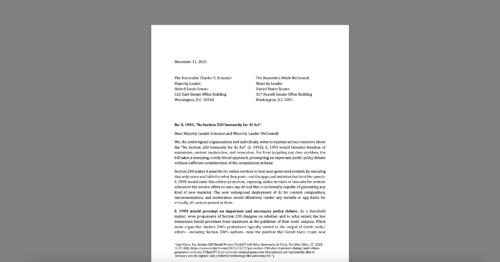
The Center for Democracy & Technology (CDT) joined a coalition letter expressing serious concerns about the “No Section 230 Immunity for AI Act” (S. 1993). S. 1993 would threaten freedom of expression, content moderation, and innovation. Far from targeting any clear problem, the bill takes a sweeping, overly broad approach, preempting an important public policy debate without sufficient consideration of the complexities at hand.
***
From the letter:
Section 230 makes it possible for online services to host user-generated content, by ensuring that only users are liable for what they post—not the apps and websites that host the speech. S.1993 would undo this critical protection, exposing online services to lawsuits for content whenever the service offers or uses any AI tool that is technically capable of generating any kind of new material. The now widespread deployment of AI for content composition, recommendation, and moderation would effectively render any website or app liable for virtually all content posted to them.
Not All Guardrails Are Created Equal: Comparing Content Safety and Copyright Filtering
As courts and policymakers work through questions about chatbot liability, they should be wary of analogies that flatten meaningful technical differences. Copyright filtering and safety intervention share real challenges around ambiguity and evasion, but they diverge in what each control must assess, how each manifests over the course of a conversation, and how much can be verified from the outside.
Op-Ed: France’s Constitutional Council Ruling Tests the Limits of Social Media Bans
Read our analysis the legal and policy significance of the Constitutional Council’s decision on ongoing social media age restriction and age assurance debates ahead of the most-anticipated EU-wide approach on child online safety due by December 2026.
The brief explains that Section 230’s liability protections are essential to enable free expression online and they extend to the use of automated systems to engage to rank and order content as part of traditional publishing activities.