CDT Join Open Letter in Response to Voatz’s Supreme Court Amicus Brief
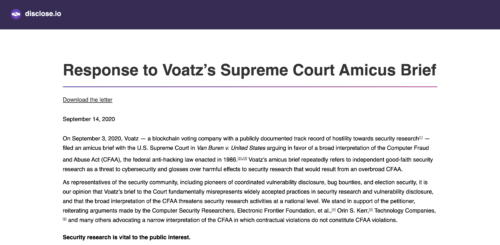
CDT added its signature to a letter in response to Voatz’s recent SCOTUS brief advocating a broad interpretation of the CFAA. We join EFF, HackerOne, and Bugcrowd and many others in the security community to further support the amicus brief that CDT, EFF, and others filed with the U.S. Supreme Court in Van Buren v. United States arguing in favor of a narrow interpretation of the Computer Fraud and Abuse Act (CFAA) enacted in 1986. On the contrary, Voatz’s amicus brief repeatedly refers to independent good faith security research as a threat to cybersecurity, and glosses over legally relevant factors of the case. CDT remains firm that security research is vital to the public interest. In our own brief we state:
“Amici write to inform the Court of the vital role that security researchers play and to demonstrate how the CFAA has hindered their work. They urge the Court to adopt a narrow construction of the law consistent with Congress’s intent and to clarify that contravening written prohibitions on means of access is not a violation of the CFAA.”
British Public Oppose Secret Surveillance Powers and Want Strong Protections for Encrypted Communications
CDT released nationally representative polling data revealing that a the British public are broadly concerned about the security, privacy, and free speech consequences of allowing law enforcement to access encrypted communications.
Changing Course to Get It Right: The Advisory Committee Reviews Its AI Evidence Rule
CDT is keeping a close eye on Proposed Federal Rule of Evidence 707, which would govern when AI-generated information can be admitted as evidence in federal court — and many state courts where the federal rules are routinely adopted — without a human expert to explain it.