Supreme Court Should Speak Up on Cell Site Location Information
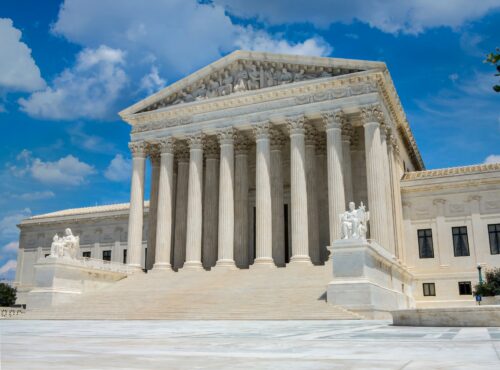
It’s time for the Supreme Court to decide whether law enforcement needs a warrant to access cell site location information (CSLI). Today, the Electronic Frontier Foundation, joined by CDT and the Brennan Center for Justice, filed briefs asking the Court to consider this question in United States v. Carpenter and Graham v. United States. The briefs argue that the Fourth Amendment protects CSLI, which can generate a “comprehensive record of a person’s public movements” and reveal sensitive information such as political, religious, and sexual associations.
Our cell phones go everywhere with us, and they transmit signals to the cell towers near us, revealing our location to our cell service provider. Even a single piece of location data can reveal sensitive personal information, and when aggregated, these data points can paint a detailed picture of a person’s life. CSLI can reveal, for example, where and when we go to medical clinics and places of worship.
Even a single piece of location data can reveal sensitive personal information…
Despite the sensitive nature of CSLI, four of the circuit courts that have considered this question have held that a warrant is not required to collect CSLI from a provider. The Third Circuit held that a magistrate may require a warrant at his or her discretion. However, the Fourth, Fifth, Sixth, and Eleventh Circuits, in finding that a warrant is not required, relied on the outdated doctrine that one cannot have a reasonable expectation of privacy in information that is voluntarily disclosed to a third party. This “third-party doctrine” comes from the 1979 case Smith v. Maryland, in which the Supreme Court found that law enforcement did not violate Smith’s reasonable expectation of privacy when they obtained the numbers he dialed directly from the phone company with a pen register order.
These petitions present the Supreme Court with a timely opportunity to reconsider the applicability of the third-party doctrine to digital data – and in particular, to CSLI. As the Third Circuit and several district and state courts have acknowledged, the concept of voluntary conveyance is a bad fit for CSLI. Cell phone use is not a choice in modern society, and cell phone users have no control over the automatic creation of location information that is generated by operation of their phones. This location information is generated even when we aren’t using our phones to make calls, send texts, or use apps.
The sensitivity of CSLI also warrants Fourth Amendment protections regardless of whether it is “voluntarily” conveyed. The ubiquity and necessity of cell phones, and the amount and granularity of information that can be gleaned from their operation , makes CSLI infinitely different from the handful of phone numbers collected in Smith v. Maryland.
The Supreme Court should take this opportunity to limit the scope of Smith so that it does not swallow Fourth Amendment protection.
Clarification of the third-party doctrine’s scope is overdue. In the digital context, the distinction between collecting information directly from a suspect and collecting it from a third party is impractical and creates absurd results. Almost all digital data is necessarily disclosed to and held by a third party. Even if the rule in Smith is limited to non-content, metadata such as email to-from information can reveal just as much sensitive data as the contents of communications.
Lower courts have questioned the wisdom of the third-party doctrine as applied to CSLI, but have lamented that their hands are tied by current precedent. The Supreme Court should take this opportunity to limit the scope of Smith so that it does not swallow Fourth Amendment protection.
CDT-led Coalition Calls for Transparency for White House AI Framework
CDT and Americans for Responsible Innovation led a broad, bipartisan coalition of over two dozen civil society groups in calling on the White House to release its Framework for review of frontier AI models.
CDT Amicus Brief Calls on Fourth Circuit to Rein In Geofence Warrants
Earlier this year the Supreme Court ruled in Chatrie v United States that the Fourth Amendment protected all cell phone location information, which CDT lauded as a landmark decision, but sent the case back down to the Fourth Circuit to assess the propriety of the geofence warrant at issue.
CDT and Partners Post Floor Alert Opposing CA SB 1013 Automated License Plate Readers Bill
The best way to ensure that Automated License Plate Readers are not abused is to limit the retention of stored data and to keep loopholes to lawful process closed. CA SB 1013 is a step in the wrong direction, and we urge the California legislature to reject this approach.
British Public Oppose Secret Surveillance Powers and Want Strong Protections for Encrypted Communications
CDT released nationally representative polling data revealing that a the British public are broadly concerned about the security, privacy, and free speech consequences of allowing law enforcement to access encrypted communications.