Properly deployed, artificial intelligence can benefit policing and enhance national security. Guardrails are needed to ensure that AI does not exacerbate existing challenges such as bias in policing and mass surveillance for intelligence gathering purposes.
Related Topics
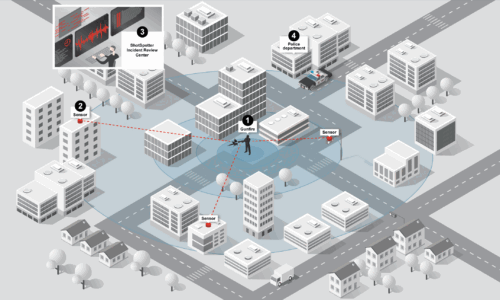
Law enforcement agencies at the local, state and federal level already deploy artificial intelligence to police populations, including to draft reports of police encounters that can turn violent. AI can be used to drive decisions about which arrestees should be detained prior to trial, and who should be released on parole after they serve their time. AI deployments also include using facial recognition technology to identify and arrest individuals, enhance license plate reader outputs to detect and describe images, and to detect gunfire and deploy police to the scene of a potential crime. These high risk applications of AI demand the utmost care, including proper authorization, testing for effectiveness and bias, and measured human judgement before action is taken based on an AI output.
AI deployment for national security purposes can be both high risk, and low transparency. In contrast to the publication of use cases for AI deployment by federal agencies for law enforcement purposes, national security use of AI can be shrouded in secrecy. Known use cases include using AI to sift through enormous volumes of intercepted communications and financial records, determining whom to target for surveillance, selecting targets for the application of kinetic force, and predicting potentially catastrophic events like terrorist attacks and the possibility of invasion. CDT advocates for independent oversight of uses of AI in the surveillance and national security contexts, and for increased transparency about AI deployments for these purposes.
AI in Policing
Police and prosecutors across the country are rapidly adopting AI tools that promise efficiency and modernization. These tools are shaping the most consequential decisions in the criminal legal process — who gets watched, who gets stopped, who gets arrested, and who gets incarcerated. A single error can result in a dangerous encounter with police or a criminal charge that takes months to unwind, but the people most impacted rarely have a say in how these tools are used, and often never learn they were used at all. To make matters worse, even when these tools work exactly as advertised, they can entrench harmful patterns of overpolicing behind a veneer of algorithmic objectivity.
Changing Course to Get It Right: The Advisory Committee Reviews Its AI Evidence Rule
CDT is keeping a close eye on Proposed Federal Rule of Evidence 707, which would govern when AI-generated information can be admitted as evidence in federal court — and many state courts where the federal rules are routinely adopted — without a human expert to explain it.
Absent meaningful guardrails, ALPRs — which can effortlessly reconstruct where a person lives, works, shops, socializes, seeks medical care, and more — can be weaponized for pervasive surveillance and misconduct
Fortunately, states are beginning to place sensible and much-needed safeguards on facial recognition. CDT recommends considering several policy priorities to address the risks of misidentification, dragnet surveillance, and other abuse of facial recognition.