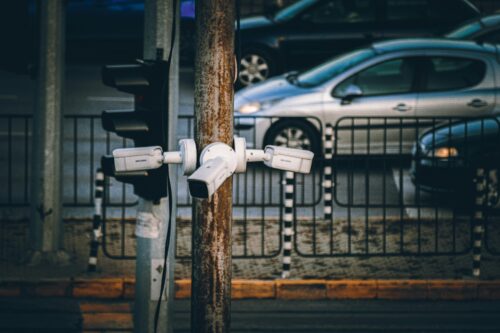
Automated license plate readers (ALPRs) are camera systems that capture images of passing vehicles, which are digitized into text files and then stored with time and location information for easy search and travel mapping. These cameras can be mounted onto traffic lights, along the sides of roads and intersections, or even hidden behind traffic cones. While law enforcement agencies have used ALPRs for over a decade, a wave of AI upgrades and the explosive growth of private networks have turned ALPRs into something far more powerful: a near-ubiquitous permanent record of where tens of millions of law-abiding drivers go every day. Motorola Solutions has a data-sharing network of over 3,700 agencies and business partners while Flock Safety operates cameras in over 6,000 communities capturing over a billion images per month.
Law enforcement agencies primarily use ALPRs and associated databases for 1) real-time alerts of vehicles on a “hotlist” — typically for stolen cars, missing persons, or wanted suspects — and 2) historical tracking of vehicles and mapping their movements, potentially spanning weeks or even months of time. With emerging data analytics tools, ALPRs are now even being used with AI to designate vehicles to pull over: Border Patrol deploys ALPRs and AI software to conduct automated analytics of driving patterns, flag vehicles the system deems “suspicion,” then subject them to carstops, as well as possible search and detainment.
Absent meaningful guardrails, ALPRs — which can effortlessly reconstruct where a person lives, works, shops, socializes, seeks medical care, and more — can be weaponized for pervasive surveillance and misconduct. Officers around the country have already been caught using ALPR access to stalk ex-partners and surveil political protestors. Various law enforcement agencies have used it to track people seeking reproductive health services and federal agencies like ICE are gaining side-door access to ALPR data to target immigrants.
Recognition of the danger unchecked ALPR surveillance poses is building. In recent months, cities including Denver, Austin, and Cambridge have ended or declined to renew their Flock contracts and some have gone so far as to cover the cameras rather than let images keep flowing to the company. 35 states have proposed nearly 100 pieces of legislation in 2026 alone. CDT recommends policymakers consider the following guardrails to address the risks of misidentification, dragnet tracking, and abuse of ALPR networks.
Warrant Rule
Law enforcement could be required to obtain a warrant based on probable cause before querying ALPR data to: 1) track a vehicle’s historical movements 2) identify vehicles that were near the scene of a crime; and 3) generate a real-time alert for a specific vehicle. This rule could also preserve exceptions for emergencies, stolen vehicles, and missing persons to ensure that law enforcement can act swiftly when necessary.
Warrants for extensive location tracking: Law enforcement frequently search ALPR databases during criminal investigations to review a person’s past movements over time. Some of these databases, like Vigilant Solutions, boast billions of records collected across states. The information can be used in various ways, from connecting co-conspirators to identifying “unusual patterns” that suggest criminality. But without strong limits it could also map highly sensitive activities of innocent people or be abused. Because of the breadth of accessible data, law enforcement can be required to show probable cause of criminal activity before obtaining a warrant to conduct extensive historical surveillance.
Warrants to identify vehicles near crime scenes: Cataloging every vehicle in an area might help build a suspect list, but could also stockpile individuals’ presence at sensitive locations. To prevent fishing or overbroad exploratory searches, accessing ALPR data to identify vehicles near a crime scene could require a warrant that includes strict limitations on both the geographic area and time period. These limitations ensure that use of ALPRs to examine crime scenes can occur, but are narrowly tailored to the needs of a specific investigation.
Warrants for hot lists that generate real-time alerts: ALPRs are commonly used to check license plates against “hot lists.” If there is a match between license plates or a “hit,” then law enforcement will be automatically alerted and an officer will be dispatched. However, without proper guardrails this could be weaponized to track and harass individuals, such as activists and protesters. Hot lists can be designed to only generate alerts for vehicles that are owned or operated by someone subject to an active arrest warrant, or vehicles determined to be involved in the commission of a felony pursuant to a warrant based on probable cause (or exceptions described above).
How It Accounts for Public Safety Needs: Core uses of ALPRs like flagging a car tied to an active arrest warrant or identifying cars near a specific crime scene comfortably meet the probable cause standard. For mapping out a suspect’s past movements to aid an investigation, police have for nearly a decade been required to get a warrant for any long-term cellphone location tracking, demonstrating such a safeguard is compatible with public safety needs.
Where It Has Been Tried: Montana and Minnesota have already enacted statutory warrant requirements for certain ALPR queries, offering workable models that other states can build on.
Other Important Considerations:
Strict Retention Limits: Agencies could require the prompt deletion of ALPR data that does not generate a hit against a hot list or match a pending investigation. Minimizing data retention helps protect individuals from broad, exploratory searches. As of 2025, eighteen jurisdictions currently have statutory limitations on how long ALPR data can be retained, ranging from three minutes in New Hampshire to five years in Alabama.
Restricted Access & Data Sharing: Access could be limited to personnel who need it, with real penalties for misuse. Out-of-state and federal agencies should only receive ALPR data if they are bound by the same warrant protections, preventing cross-border searches absent safeguards. As of 2025, fourteen jurisdictions include civil and/or criminal penalties for misusing or knowingly accessing ALPR data by individuals not permitted by law to access such data.
Mandatory Transparency & Auditing: Every ALPR search could require a logged case number and justification. Searches can be subject to independent audit, and agencies can publish annual reports on how many cameras they operate, how many hits those cameras generate, and how often those hits produce a legitimate public safety outcome. As of 2025, eleven states require ALPR logs and eleven jurisdictions require reports on the outlined criteria.
Discovery & Preservation Rights: Defendants can be able to obtain the full audit trail of any ALPR search used against them, and agencies should be required to honor reasonable requests to preserve potentially exculpatory location data. Minnesota, Nebraska, Utah and have instated protections to preserve data upon defendants’ requests and Virginia grants defendants rights to obtain audit trails.
British Public Oppose Secret Surveillance Powers and Want Strong Protections for Encrypted Communications
CDT released nationally representative polling data revealing that a the British public are broadly concerned about the security, privacy, and free speech consequences of allowing law enforcement to access encrypted communications.
CDT Joins Letter and Calls on Senate Judiciary and Homeland Security Committee to Close the Data Broker Loophole
CDT called on Senate leaders to highlight a new multi-year agreement between the Department of Homeland Security and Thomson Reuters for access to Americans’ sensitive data, calling on Congress to close the data broker loophole.
Changing Course to Get It Right: The Advisory Committee Reviews Its AI Evidence Rule
CDT is keeping a close eye on Proposed Federal Rule of Evidence 707, which would govern when AI-generated information can be admitted as evidence in federal court — and many state courts where the federal rules are routinely adopted — without a human expert to explain it.