This is the second piece in CDT’s “AI In Policing” series, in which we explore how police use various AI technologies for surveillance and investigations, the risks posed, and how we should respond.
Images show that sounds being picked up by microphones include those of gunshots, fireworks, a jackhammer, a car door slamming, and a marching band. Source: Campaign Zero CancelShotSpotter.
Gunshot detection technology is an AI technology deployed in many cities across the country. But while this technology is framed as a way to streamline gunfire detection and response, studies and analysis in many cities have shown that its efficacy is highly limited, with one mayor calling it a “gimmick” after his city spent millions on it. The technology has also been used to inflate evidence in weak prosecutions, and it can promote disparate policing practices.
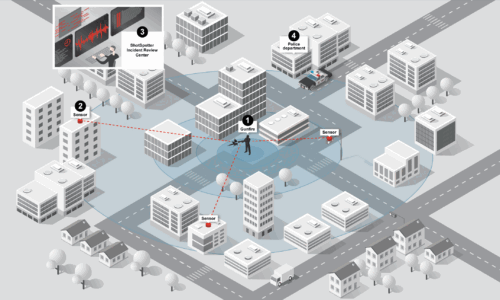
Gunshot detection technology is one of the oldest and most broadly deployed AI technologies used in policing. As used by police departments, it works by placing microphones across a neighborhood. When a noise is detected, software analyzes it and provides an alert if the system believes the sound was a gunshot. The system also calculates how far the sound was from various microphones, and uses the relative distances to triangulate the location from which the sound came. Theoretically these automated alerts prompt police to quickly respond to and arrive at the scene of gunfire.
A number of firms offer this technology to police departments in the U.S., and have been doing so for over a decade. The leading vendor, Soundthinking, offers a service called ShotSpotter that it says is deployed by over 180 cities across the United States. Because ShotSpotter dominates the market, this piece focuses on the deployment of Shotspotter, and its less than impressive results.
Risks
How it might not work….
Gun detection systems like ShotSpotter are only as effective as their ability to distinguish gunshots from all other noises. But it can be incredibly difficult to separate out the sound of gunfire from other sharp loud sounds such as a car backfiring or a firecracker.
Studies and investigative reports evaluating the efficacy of ShotSpotter have been highly critical. A Chicago Inspector General report found that over a 17-month period from 2020 to 2021 ShotSpotter generated over 50,000 alerts, but they led to discovery of evidence of gun-related crimes less than 10% of the time. The report concluded that “[Chicago Police Department] responses to ShotSpotter alerts rarely produce documented evidence of a gun-related crime.” A MacArthur Justice Center analysis of Chicago’s use of the technology the following year similarly found dispatches based on ShotSpotter alerts did not lead to evidence of gun-related crimes over 90% of the time. In New York City, a comptroller audit revealed that only 13% of ShotSpotter alerts resulted in confirmed shootings. An investigative report by the Houston Chronicle found that over 80 percent of ShotSpotter alerts did not even result in an incident report being filed. An investigative report in Dayton found police filed a report indicating a crime for just 5 percent of Shotspotter alerts. And a study by St. Louis police found that “For all 19,000+ [gunshot detection technology] calls over the last decade, police officers were led to the scenes of 5 homicides, 58 aggravated assaults, and 2 robberies (many of which were also called in by community members),” concluding that “[f]or a city with between 100 to 200 homicides annually, this is not exactly a great catch.”
While it is possible that these failures to discover actual gun-related crimes from alerts are due to investigative limitations, research indicates that false positives are a common culprit. According to the Houston Chronicle report, the rate of incident reports filed following ShotSpotter alerts was half of that for traditional 911 calls. The report on use in St. Louis was even more damning, finding that the rate of crime incidents identified via regular community calls was over eight times higher than for ShotSpotter. Regardless of the exact percentage of alerts from gunshot detection technology that are false positives, the vast majority are failing to provide any value to public safety.
Unfounded ShotSpotter alerts cause a variety of harms. First and foremost, they serve as a prime example of artificial intelligence creating an artificial basis for subjecting individuals to policing and surveillance. According to the Chicago Inspector General report, its Shotspotter alerts resulted in over 1000 stops and over 800 pat downs. Those encounters did lead to 244 arrests, but it is unknown how many related to gun crimes or their ultimate disposition. And as the Inspector General highlighted, “fewer than 2 in 10 investigatory stops following ShotSpotter alerts resulted in the recovery of a gun.”
Gunshot detection has also been co-opted for AI-puffery, using the framing of a high-tech tool to embellish flimsy cases: In Chicago Michael Williams spent nearly a year in jail after being wrongly charged based on a ShotSpotter alert. In the Williams case and in other investigations, ShotSpotter reportedly altered its analysis so the data it produced would support prosecutors’ narratives. A Vice investigative report found that Shotspotter employees “frequently modify alerts at the request of police departments” — such as changing the system’s designation of a sound from fireworks to gunfire — in order to support prosecutions “grasping for evidence that supports their narrative of events.”
Further, these alerts cause a significant waste of police resources, with officers forced to respond to alerts that turn out to be nonexistent shots in the dark the overwhelming majority of the time. According to the New York City comptroller report, the NYPD wasted over 426 officer-hours responding to unfounded and unconfirmed ShotSpotter alerts in a single month. The comptroller report concluded this “potentially represents significant waste of officer hours. This in turn has fiscal consequences which the City can ill-afford.” Finally, despite providing little value, ShotSpotter programs carry significant costs to cities’ budgets, costing hundreds of thousands or even millions of dollars per year.
Risks even if it does work …
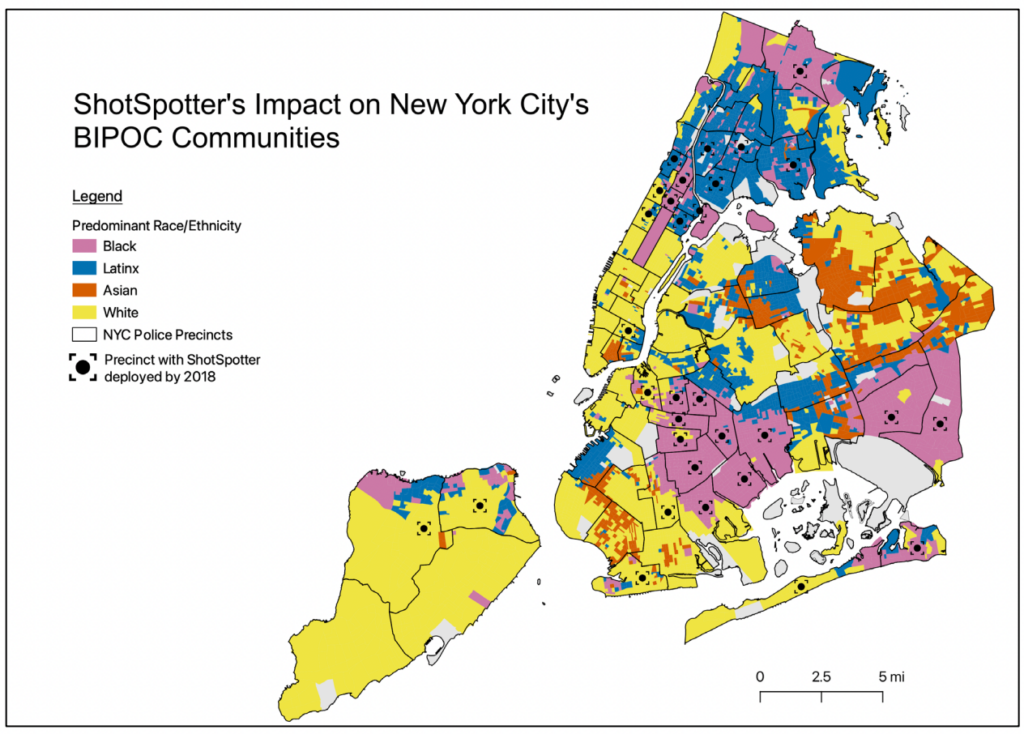
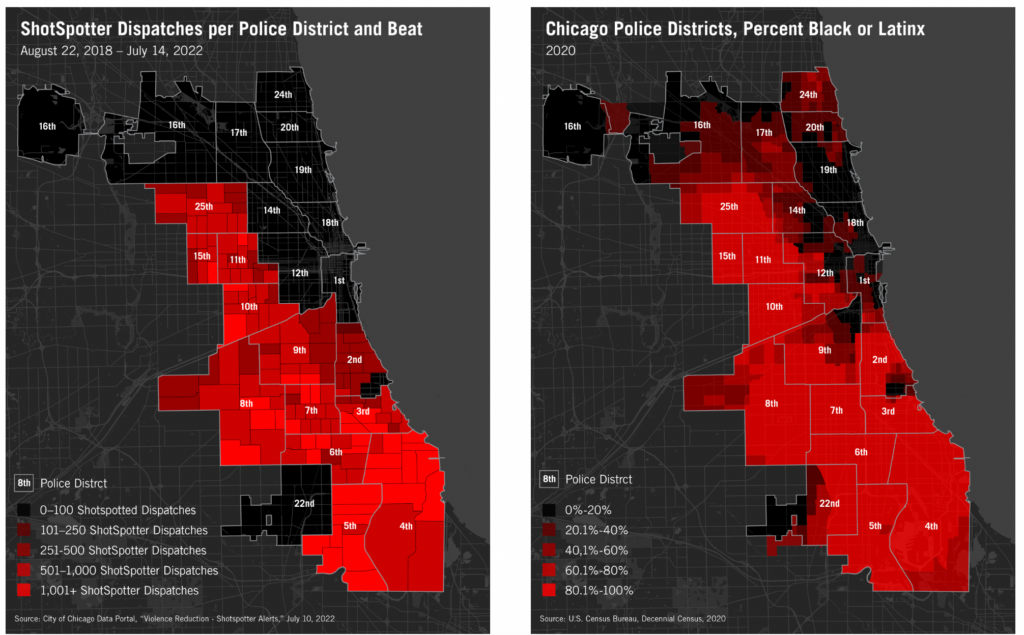
Map of New York City showing majority demographics in each precinct, with an overlay of ShotSpotter deployments. The vast majority of deployments are in majority Black or majority Latinx precincts. Source: Surveillance Technology Oversight Project’s “ShotSpotter and the Misfires of Gunshot Detection Technology” report.Side by side precinct maps of Chicago showing the highest concentration of Shotspotter dispatches in the neighborhoods that have the highest concentration of Black or Latinx residents. According to the MacArthur Justice Center, “The twelve ShotSpotter districts are exactly those with the highest proportion of Black and Latinx residents—and the lowest proportion of White residents.” Source: MacArthur Justice Center.
Even if gunshot detection systems did become more reliable, they would still present serious risks of amplifying disparate policing practices. Deployments in major cities such as New York City and Chicago show significant correlation between the neighborhoods with high proportions of Black and Latino residents and the neighborhoods with high presence of ShotSpotter microphones. Disproportionate deployments of these systems will lead to higher levels of police being dispatched into majority-minority communities that are already over-policed, while cloaking these practices as an “unbiased” response to AI recommendations.
But the tide may be turning. Chicago, San Antonio and Charlotte have ceased using ShotSpotter, and Houston appears poised to do so as well.
Recommendations and Conclusion
Gunshot detection systems serve as a stark warning of how new AI technologies may not live up to vendors’ hype. These technologies may be touted as sci-fi wonders. But in reality, their efficacy is doubtful, and they waste public safety resources and misdirect investigations towards innocent individuals. Cities should treat ShotSpotter with the utmost skepticism, and those localities that use its systems should consider whether taxpayer funds are better spent elsewhere.
CDT-led Coalition Calls for Transparency for White House AI Framework
CDT and Americans for Responsible Innovation led a broad, bipartisan coalition of over two dozen civil society groups in calling on the White House to release its Framework for review of frontier AI models.
CDT Amicus Brief Calls on Fourth Circuit to Rein In Geofence Warrants
Earlier this year the Supreme Court ruled in Chatrie v United States that the Fourth Amendment protected all cell phone location information, which CDT lauded as a landmark decision, but sent the case back down to the Fourth Circuit to assess the propriety of the geofence warrant at issue.
CDT and Partners Post Floor Alert Opposing CA SB 1013 Automated License Plate Readers Bill
The best way to ensure that Automated License Plate Readers are not abused is to limit the retention of stored data and to keep loopholes to lawful process closed. CA SB 1013 is a step in the wrong direction, and we urge the California legislature to reject this approach.
British Public Oppose Secret Surveillance Powers and Want Strong Protections for Encrypted Communications
CDT released nationally representative polling data revealing that a the British public are broadly concerned about the security, privacy, and free speech consequences of allowing law enforcement to access encrypted communications.