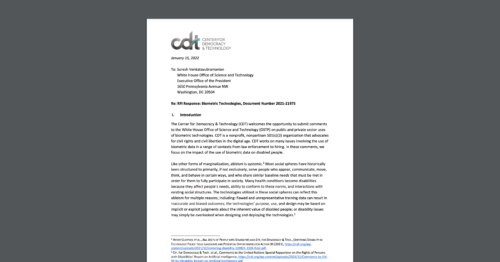
CDT Comments to OSTP Highlight How Biometrics Impact Disabled People
In late 2021, the White House Office of Science Technology and Policy (OSTP) launched its AI Bill of Rights initiative to address AI systems that enable and worsen discrimination and privacy risks, particularly in the technologies society has grown to depend on most. CDT submitted comments to the OSTP on the impact of biometric technologies on disabled people, discussing how biometrics incorporated into decision-making and surveillance have disproportionately harmed multiply-marginalized disabled people.
Not All Guardrails Are Created Equal: Comparing Content Safety and Copyright Filtering
As courts and policymakers work through questions about chatbot liability, they should be wary of analogies that flatten meaningful technical differences. Copyright filtering and safety intervention share real challenges around ambiguity and evasion, but they diverge in what each control must assess, how each manifests over the course of a conversation, and how much can be verified from the outside.
Talking Tech with Roy Austin & Alex Givens on The Future of AI Governance
In this episode of CDT’s Tech Talks, Roy L. Austin, Jr., inaugural director of Howard University School of Law’s AI Initiative, joins Alexandra Givens, President and CEO of the Center for Democracy & Technology, to discuss the challenges and opportunities shaping the future of AI.
CDT-led Coalition Calls for Transparency for White House AI Framework
CDT and Americans for Responsible Innovation led a broad, bipartisan coalition of over two dozen civil society groups in calling on the White House to release its Framework for review of frontier AI models.
Comment to House Financial Services Committee on Regulation of AI
CDT submitted comments on the application of current federal laws and regulations related to the use of AI in the financial marketplace and any proposed reforms to provide for an appropriately modernized and comprehensive federal financial AI framework.