Not All Guardrails Are Created Equal: Comparing Content Safety and Copyright Filtering
As courts and policymakers work through questions about chatbot liability, they should be wary of analogies that flatten meaningful technical differences. Copyright filtering and safety intervention share real challenges around ambiguity and evasion, but they diverge in what each control must assess, how each manifests over the course of a conversation, and how much can be verified from the outside.
The norms of conversational advertising are being written right now by companies. Policy should be written alongside them, and it should start with recognizing that surreptitious manipulation at scale built on intimate information is itself a privacy harm, and a privacy law can, in part, solve some of those issue
Talking Tech with Roy Austin & Alex Givens on The Future of AI Governance
In this episode of CDT’s Tech Talks, Roy L. Austin, Jr., inaugural director of Howard University School of Law’s AI Initiative, joins Alexandra Givens, President and CEO of the Center for Democracy & Technology, to discuss the challenges and opportunities shaping the future of AI.
CDT-led Coalition Calls for Transparency for White House AI Framework
CDT and Americans for Responsible Innovation led a broad, bipartisan coalition of over two dozen civil society groups in calling on the White House to release its Framework for review of frontier AI models.
CDT and Partners Post Floor Alert Opposing CA SB 1013 Automated License Plate Readers Bill
The best way to ensure that Automated License Plate Readers are not abused is to limit the retention of stored data and to keep loopholes to lawful process closed. CA SB 1013 is a step in the wrong direction, and we urge the California legislature to reject this approach.
The Center for Democracy and Technology has joined with civil society partners to oppose California’s SB 690, which would amend the California Invasion of Privacy Act (CIPA) to retroactively remove private rights of action against companies using pen registries to track individuals.
The 2026 legislative session has shown a continued but shifted focus on the regulation of artificial intelligence (AI), with most bills — both introduced and passed — grappling with the rise and use of chatbots in a variety of contexts.
CDT and Partners Urge Passage of the California Location Privacy Act of 2025 (AB 322)
Location data is particularly sensitive, and when collected across time it can reveal a broad range of intrusive insights such as medical conditions, sexual orientation, political activities, and religious beliefs.
How Policymakers Can Address AI Auditing and Assessment Requirements
As more state policymakers consider third-party AI auditing or assessment requirements, these policies face important challenges to their effectiveness.
When the Algorithmic Odds are Not in your Favor: Algorithmic Poisoning and the 2026 U.S. Midterms
As the 2026 midterms approach, policymakers, election officials, and AI developers and deployers share responsibility for understanding how algorithmic poisoning operates and taking concrete steps to reduce its impact.
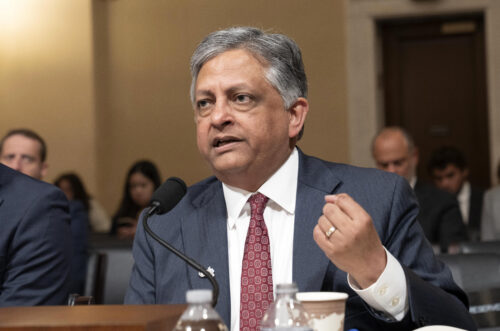
CDT VP Testifies on State and Local Cybersecurity Threats and the Federal Retreat
On May 21, 2026, CDT Vice President of Policy Samir Jain testified before the U.S. House of Representatives Committee on Homeland Security’s Subcommittee on Cybersecurity and Infrastructure Protection on the cybersecurity threats facing state and local governments.
State Legislatures Continued Their Focus on Public Sector AI Use and Expanded Attention to Risk Management Practices During the 2025 Legislative Session