CDT Files Amicus Brief in Meta Platforms v. Bonta
On September 15, 2026, the Center for Democracy & Technology and Electronic Frontier Foundation filed an amicus brief along with the Wikimedia Foundation in Meta Platforms v. Bonta, challenging California’s SB 976.
Coalition Urges Senate Not to Let Companies Waive Financial Regulations for AI
CDT joined AI Now Institute, American Civil Liberties Union, and several organizations dedicated to tech policy, consumer protection, and civil rights in a letter to Senate leadership and the Senate Banking, Housing, and Urban Affairs Committee opposing the “AI Innovation Labs” language in Sec. 10509 of the CLARITY Act.
Proposals for Third-Party AI Assessment in 2026
As concern about risks and harms related to AI systems continue to grow, a growing chorus of policymakers, industry leaders, and advocates have called for independent AI assessments. This explainer provides an overview of recent proposals for third-party assessment in the United States, including state and federal legislation, executive actions, and industry proposals.
Getting Third-Party AI Assessment Right
Having third parties assess AI systems might seem like common sense, but crafting effective policies toward this goal can be devilishly tricky. A poorly-constructed ecosystem for third-party assessment could easily fail to consider the most consequential mechanisms of risk, neglect the AI harms that most impact people, or do more to protect AI companies than people.

Latest
105 Results
CDT Leads Letter to New York City Council on Pending Automated Employment Tools Bill
Report – Data Ethics in Education and the Social Sector: What Does It Mean and Why Does it Matter?
CDT Letter in Support of Washington State’s SB-5116
Tech Talk: Disability Benefits & Algorithms — Talking Tech W/ Lydia X. Z. Brown & Alexandra Givens
How Opaque Personality Tests Can Stop Disabled People from Getting Hired
Faster is Not Always Better – Disability Discrimination in Algorithm-driven Hiring Tools
Report – Algorithm-driven Hiring Tools: Innovative Recruitment or Expedited Disability Discrimination?
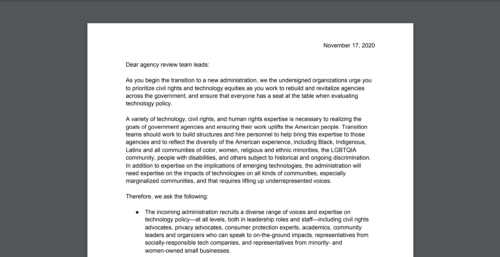
CDT Joins Letter Urging New Administration’s Agency Review Teams to Prioritize Civil Rights and Technology Equities
How Automated Test Proctoring Software Discriminates Against Disabled Students
Americans with Disabilities Act at 30: Where We’ve Come From and Where Tech Needs to Go Next
Report: Challenging the Use of Algorithm-driven Decision-making in Benefits Determinations Affecting People with Disabilities
What Happens When Computer Programs Automatically Cut Benefits That Disabled People Rely on to Survive
CDT Partners with Leadership Conference on Civil Rights Principles on the Use of AI in Hiring
Critical Scrutiny of Predictive Policing is a Step to Reducing Disability Discrimination