

Welcome back to the Centre for Democracy & Technology Europe‘s Tech Policy Brief! This edition covers the most pressing technology and internet policy issues under debate in Europe and gives CDT’s perspective on the impact to digital rights.
To sign up for CDT Europe’s EU Tech Policy Brief and AI Bulletin newsletters, please visit our dedicated website page. Do not hesitate to contact our team in Brussels.
👁️ Security and Surveillance
Danish Presidency Proposal on EU Child Sexual Abuse Regulation Raises Concerns
As part of its ongoing efforts to defend strong encryption, CDT Europe joined members of the Global Encryption Coalition Steering Committee in issuing a statement on the Danish Presidency’s 1 July compromise text of the proposed EU Child Sexual Abuse Regulation. The statement highlights that the draft text not only keeps the most concerning aspects of earlier proposals but goes further by mandating that service providers scan for both known and unknown material in end-to-end encrypted environments. The Steering Committee warns that such client-side scanning measures are ineffective, as perpetrators can easily circumvent detection, while at the same time introducing serious new vulnerabilities into digital communications systems. Beyond the technical flaws, the proposal also raises profound fundamental rights concerns, conflicting with the EU Charter of Fundamental Rights and European human rights jurisprudence. The statement urges EU Ministers to reject approaches that undermine end-to-end encryption and to focus instead on solutions that are technically sound, rights-respecting, and truly effective in protecting children. Regulation that weakens security and threatens rights without delivering meaningful child protection is not a trade-off the EU should accept.
Public Consultation on an EU Initiative on Retention of Data by Service Providers for Criminal Proceedings
CDT Europe submitted feedback to the European Commission’s public consultation on an EU initiative on the retention of data by service providers for criminal proceedings. In its response, CDT Europe underlined that any future framework for data retention must be fully consistent with the Charter of Fundamental Rights, the case law of the Court of Justice of the European Union (CJEU), and the principles of necessity and proportionality. Our response further stressed that untargeted retention mandates not only threaten privacy but also risk undermining law enforcement, since evidence obtained in breach of EU law may be inadmissible in national proceedings. Instead, CDT Europe recommended a narrowly targeted, judicially supervised approach to data preservation, allowing retention of specific metadata only where it is demonstrably relevant to a serious crime. The submission also cautioned against extending indiscriminate retention obligations to number-independent interpersonal communications services, many of which are designed precisely to minimise or avoid storing user data. CDT Europe urged the Commission and legislators to rule out bulk retention mandates and to develop a framework that supports effective investigations while safeguarding privacy, security, and democratic values.
Recommended read: Follow the Money, Spyware industry pockets EU subsidies while snooping on its citizens
💬 Online Expression & Civic Space
Public Consultation on the Next Gender Equality Strategy
After attending the in-person civil society consultation held by the European Commission DG JUST in Brussels last June, CDT Europe recently submitted a written response to the public consultation on the next Gender Equality Strategy (2026-2030). In our reply to the consultation, we provided some key recommendations on how the Strategy can most effectively address tech-facilitated gender-based violence (TFGBV). In particular, we focused on the response to online harassment and abuse, and the promotion of political participation and equal representation of women. We stressed the importance of the Strategy aligning with the existing legislative framework, namely the Directive on Violence Against Women and Domestic Violence, the DSA, and all other relevant legislations, and highlighted ways to adopt a more gender-sensitive approach to enforcing and implementing the EU’s Digital Agenda.
Independent Tech Researchers’ Summit

CDT Europe’s David Klotsonis facilitated a session at the Independent Tech Researchers’ Summit in Berlin — the first in-person summit of the Coalition for Independent Technology Research (CITR). Over two days of workshops and breakout sessions the Coalition brought together academics, journalists, civil society researchers and community scientists to discuss the current state of research in tech at a time when institutions, journalists and researchers are under threat. Discussions revolved around strategies for collective action and opportunities for new collaborations. CDT Europe offered insights on the enforcement of the DSA and how researchers can make the most out of the new transparency framework established under Article 40, in combination with other entry-points for data, such as yearly reports by out-of-court settlement bodies and trusted flaggers, as well as the risk assessment and audit report.
Recommended read: AI Forensics – Technical Report | AgeGO Age Verification on Pornographic Platforms
⚖️ Equity and Data
Seventh Civil Society Roundtable “Ensuring the Effective Implementation of the AI Act: Charting a Way Forward”
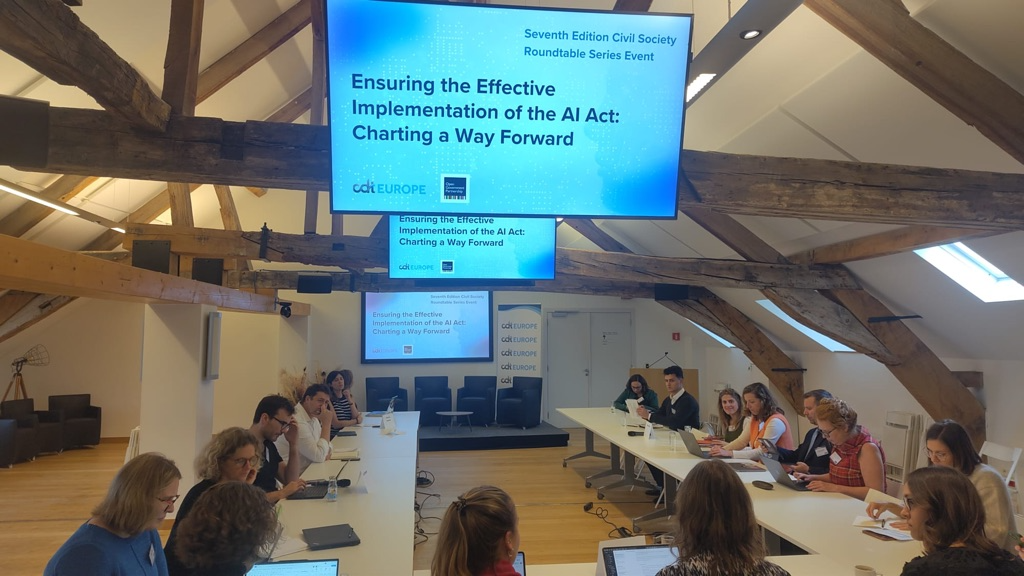
As part of our joint civil society roundtable series with the Open Government Partnership, CDT Europe organised a roundtable on the effective implementation of the AI Act. One year after the adoption of this law, the focus has shifted away from ensuring a strong, fundamental rights-based implementation towards deregulation and calls for delays of crucial parts of the act. This event aimed to recentre the debate around effective fundamental rights protection under the AI Act, and included speakers representing the Danish Presidency of the Council, civil society, national fundamental rights and data protection authorities, and the UN, as well as EU institutions and agencies. Panelists and participants exchanged ways forward to ensure the effective protection of people’s rights. The discussion also included considerations regarding the place of the AI Act in the global AI governance landscape. Two breakout sessions were dedicated to the establishment of enforcement structures at national level, including the perspectives and challenges of the authorities involved, as well as governance aspects at the European level and ways of cooperation for civil society. The discussions laid an important basis for future work advocating towards a meaningful, rights-based implementation and enforcement of the law.
Keeping National AI Act Implementation on Track
CDT Europe joined 30 other CSOs asking the European Commission and Member States for a timely implementation of the AI Act. Although the deadline to designate national enforcement bodies has passed, almost no Member State has set up the relevant structures. In the letter, we therefore urge Member States to fulfil their obligations under the law and urge the Commission not hesitate to use its oversight powers to press Member States to act.
Recommended read: Project Syndicate, The False Promise of AI for Social Good
📢 CDT Europe’s Team Welcomes Two New Members
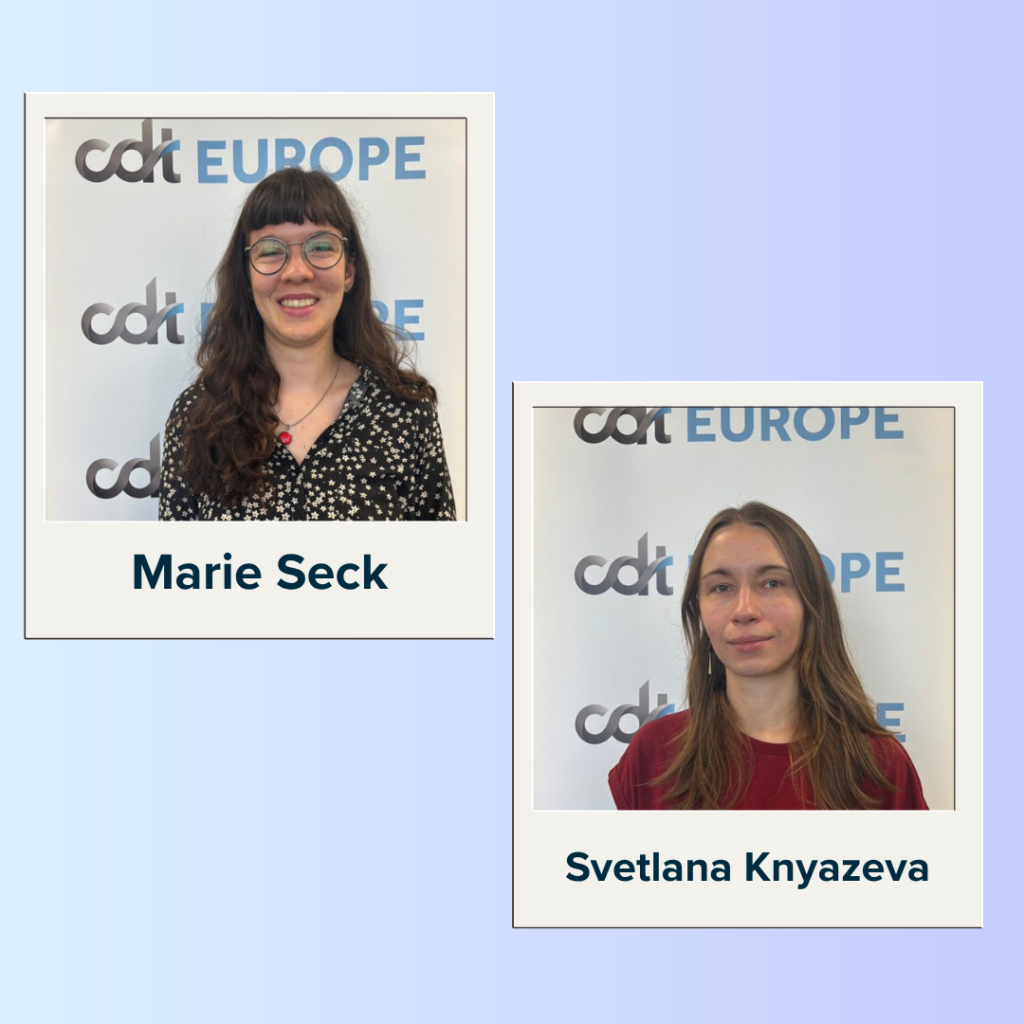
With the new season, we welcomed two new members to CDT Europe’s team! Marie Seck is our new Online Expression and Civic Space Programme Intern; with a background in human rights and gender equality, she will support the programme’s research and advocacy on key EU policy developments relating to online expression, such as the Digital Services Act (DSA) and its delegated acts, and the upcoming Digital Fairness Act (DFA). Svetlana Knyazeva, Operations & Finance Manager, will also join us to strengthen the organisation’s financial and administrative systems. We are excited to be working together!
⏫ Upcoming Events
- “Stop Chat Control” Webinar by The Greens/EFA: On 30 September, our Secretary General Asha Allen will speak in a webinar on the proposed Chat Control legislation, hosted by Greens MEP Markéta Gregorová. You can follow the live streaming here.
- Media Freedom Rapid Response Summit 2025: On 13 October, CDT Europe’sSecretary General Asha Allen will be participating in the MFRR Summit on Safeguarding Journalism and Defending Democracy. She will be speaking on a panel on spoofing, surveillance, and spyware, and how to protect journalists against digital threats. If you would like to attend, you can register here.
- 9th Annual Brussels Privacy Symposium 2025: On 14 October, our Equity & Data Programme Director Laura Lazaro Cabrera will speak at the 9th edition of the Brussels Privacy Symposium. She will be participating in a panel discussion on the point of tensions and overlap between the AI Act and GDPR, which have been central to the recent digital regulatory simplification discussion. You can get your tickets here.
- CDT’s Tech Prom: On 23 October, part of CDT Europe’s team will travel to the US to join CDT’s Global team for Tech Prom 2025 in Washington D.C. This annual convening and fundraiser is an opportunity for deeper connections and richer conversations, together with the top leaders and innovators in tech policy from government, industry, and civil society.
🆕 Job Opportunity in Brussels: Join CDT Europe’s Team!
Are you passionate about digital rights, EU tech policy, and democracy? Do you have a particular expertise in issues related to spyware, encryption and protection from government surveillance? We’re looking for a motivated individual to become our next Policy and Research Officer for the Security, Surveillance & Human Rights programme. The Policy Officer will work on conducting research and developing analyses in relation to spyware regulation, in addition to supporting the Programme Director in the management and coordination of a civil society coalition on spyware, and engaging with EU institutions, industry, civil society partners and other relevant stakeholders on relevant files. Deadline to apply: 19 October 2025. For more information, visit our website.
🗞️ In the Press
- Tech Radar, 4 regions you didn’t know already had age verification laws — and how they’re enforced
- Euronews, Will regulation make the EU the most trusted power in AI?
- Euronews, Draghi calls for pause to AI Act to gauge risks
- Maldita.es, De educación mediática a una policía cibernética: los esfuerzos de España, Ucrania y Rumanía para proteger a los menores de la violencia digital y los desafíos de la IA