CDT’s Comments for the Advisory Committee on Data for Evidence Building
CDT’s Equity in Civic Tech team focuses on ensuring that governments can use data to create evidence-based policy and provide services to individuals while protecting their privacy.
The team filed comments with the Advisory Committee on Data for Evidence Building to urge it to center equity, privacy, and ethics at the heart of federal data. Those principles can help ensure that the collection and use of federal data will help provide equitable government services and increase economic mobility while preserving individual and organizational privacy and autonomy.
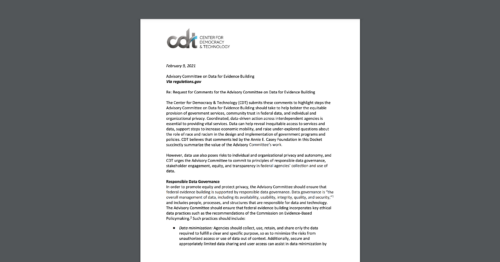
The Center for Democracy & Technology (CDT) submits these comments to highlight steps the Advisory Committee on Data for Evidence Building should take to help bolster the equitable provision of government services, community trust in federal data, and individual and organizational privacy. Coordinated, data-driven action across interdependent agencies is essential to providing vital services. Data can help reveal inequitable access to services and data, support steps to increase economic mobility, and raise under-explored questions about the role of race and racism in the design and implementation of government programs and policies. CDT believes that comments led by the Annie E. Casey Foundation in this Docket succinctly summarize the value of the Advisory Committee’s work.
However, data use also poses risks to individual and organizational privacy and autonomy, and CDT urges the Advisory Committee to commit to principles of responsible data governance, stakeholder engagement, equity, and transparency in federal agencies’ collection and use of data.
The Privacy Paradox: How Government Data Has Become Less Private and Less Useful
Providing ready access to information collected and maintained by the government promotes accountability, innovation, and research, making transparency a core responsibility of serving as a steward of the public’s data. Public agencies must also safeguard sensitive information when making data publicly available.
Defending State Data: Lessons from California v. USDA
As the federal government increasingly seeks access to state administrative data, policymakers should consider not only legal authority and privacy implications, but also the practical effects on public confidence, program effectiveness, and states’ ability to fulfill their obligations to residents.
CDT, EFF, EPIC, and Upturn Submit Comments on GSA’s Updated Draft AI Terms and Conditions for Federal Contracts
Today, the Center for Democracy & Technology and allies submitted comments to the General Services Administration (GSA) in response to the request for comment regarding their updated draft AI Terms and Conditions for federal solicitations and contracts.
Bias at Scale: Understanding AI’s Impact on Student Achievement and Opportunity Gaps
Schools have an opportunity and responsibility to ensure that new technologies support, rather than undermine, their longstanding goal of expanding opportunity.