CDT Submits Comments to Oversight Board on Governing Chatbots for 13–17 Year Olds
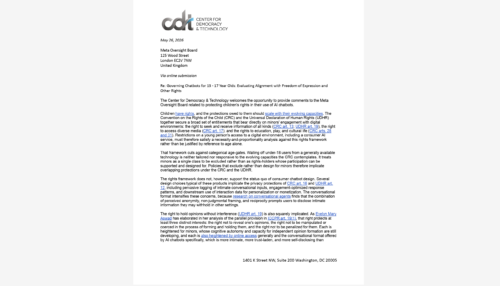
Yesterday, CDT submitted comments to the Meta Oversight Board’s consultation on governing AI chatbots for 13–17 year olds. The submission centers children’s rights as the starting point for chatbot governance, drawing on the Convention on the Rights of the Child and the Universal Declaration of Human Rights to argue that minors are rights-holders whose access to information, privacy, freedom of expression, and freedom of opinion must be actively protected.
The rights-respecting response is not exclusion but appropriate design. Teens have the right to seek and receive information, participate in cultural and educational life, and form opinions free from manipulation or coercion. These rights are particularly affected by the intimate, trust-laden nature of conversational AI. Pervasive logging, engagement-optimized design, and sycophantic outputs all implicate these protections, as do blunt restrictions that foreclose access to beneficial resources.
Drawing in part on CDT’s 2025 research report What Kids and Parents Want, which surfaced parents’ and teens’ perspectives on widely proposed social media safety interventions, the submission urges a shift toward design that empowers young users: meaningful choice and control, minimized engagement-maximizing tactics, language that avoids suggesting chatbots can “think” or “feel,” and safeguards that work across languages and contexts.
Not All Guardrails Are Created Equal: Comparing Content Safety and Copyright Filtering
As courts and policymakers work through questions about chatbot liability, they should be wary of analogies that flatten meaningful technical differences. Copyright filtering and safety intervention share real challenges around ambiguity and evasion, but they diverge in what each control must assess, how each manifests over the course of a conversation, and how much can be verified from the outside.
Op-Ed: France’s Constitutional Council Ruling Tests the Limits of Social Media Bans
Read our analysis the legal and policy significance of the Constitutional Council’s decision on ongoing social media age restriction and age assurance debates ahead of the most-anticipated EU-wide approach on child online safety due by December 2026.
The brief explains that Section 230’s liability protections are essential to enable free expression online and they extend to the use of automated systems to engage to rank and order content as part of traditional publishing activities.