CDT Files Joint Amicus Brief in U.S. v Hay Warrantless Surveillance Case
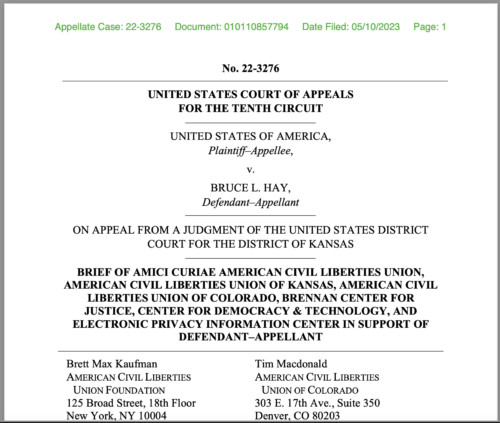
This week, the Center for Democracy & Technology filed a joint amicus brief to the 10th Circuit Court of Appeals for the case United States v. Hay in partnership with the ACLU, the Brennan Center, and the Electronic Information Privacy Center.
The Hay case involves the government placing a pole camera outside a home and continuously recording weeks of footage of the residence without a warrant. We argue that permitting this type of invasive surveillance absent a warrant gives the government excess power to monitor and stockpile details about the intimate details of individuals’ lives, upending the balance between a government and its citizens in a way that is incompatible with a democratic society.
Our brief highlights how reduced costs and emerging video analytic technology takes the power of this surveillance far beyond what traditional stakeouts could ever accomplish. CDT previously submitted an amicus brief raising objections to warrantless pole camera surveillance in the First Circuit case United States v. Moore-Bush.
CDT-led Coalition Calls for Transparency for White House AI Framework
CDT and Americans for Responsible Innovation led a broad, bipartisan coalition of over two dozen civil society groups in calling on the White House to release its Framework for review of frontier AI models.
CDT Amicus Brief Calls on Fourth Circuit to Rein In Geofence Warrants
Earlier this year the Supreme Court ruled in Chatrie v United States that the Fourth Amendment protected all cell phone location information, which CDT lauded as a landmark decision, but sent the case back down to the Fourth Circuit to assess the propriety of the geofence warrant at issue.
CDT and Partners Post Floor Alert Opposing CA SB 1013 Automated License Plate Readers Bill
The best way to ensure that Automated License Plate Readers are not abused is to limit the retention of stored data and to keep loopholes to lawful process closed. CA SB 1013 is a step in the wrong direction, and we urge the California legislature to reject this approach.
British Public Oppose Secret Surveillance Powers and Want Strong Protections for Encrypted Communications
CDT released nationally representative polling data revealing that a the British public are broadly concerned about the security, privacy, and free speech consequences of allowing law enforcement to access encrypted communications.