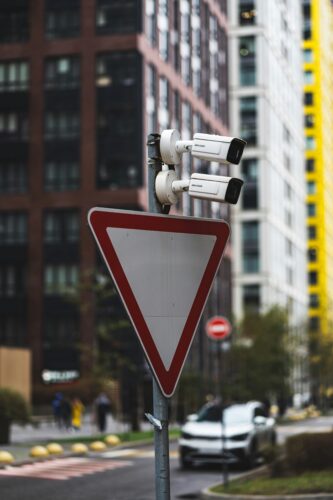
The Center for Democracy & Technology filed an amicus brief in the First Circuit Court of Appeals in United States v. Moore-Bush arguing that persistent, warrantless law enforcement video surveillance of a home constitutes an unreasonable search. For eight months, without a warrant, law enforcement placed a home under persistent video surveillance using a camera placed on a utility pole (‘pole camera’). With a view of the driveway and the front of the house, law enforcement officers could—remotely and at their leisure—monitor the comings and goings of the residents of the home, their visitors, and any passers-by. The camera could be remotely panned, tilted, and zoomed in, and the recorded footage could be reviewed via a searchable digital log.
We are grateful to Trisha Anderson, Alexander Berengaut, and Jadzia Pierce of Covington & Burling LLP for representing CDT on this brief.
CDT-led Coalition Calls for Transparency for White House AI Framework
CDT and Americans for Responsible Innovation led a broad, bipartisan coalition of over two dozen civil society groups in calling on the White House to release its Framework for review of frontier AI models.
CDT Amicus Brief Calls on Fourth Circuit to Rein In Geofence Warrants
Earlier this year the Supreme Court ruled in Chatrie v United States that the Fourth Amendment protected all cell phone location information, which CDT lauded as a landmark decision, but sent the case back down to the Fourth Circuit to assess the propriety of the geofence warrant at issue.
CDT and Partners Post Floor Alert Opposing CA SB 1013 Automated License Plate Readers Bill
The best way to ensure that Automated License Plate Readers are not abused is to limit the retention of stored data and to keep loopholes to lawful process closed. CA SB 1013 is a step in the wrong direction, and we urge the California legislature to reject this approach.
British Public Oppose Secret Surveillance Powers and Want Strong Protections for Encrypted Communications
CDT released nationally representative polling data revealing that a the British public are broadly concerned about the security, privacy, and free speech consequences of allowing law enforcement to access encrypted communications.