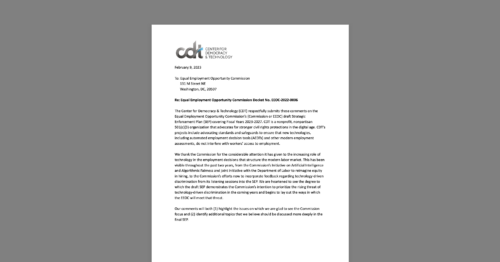
CDT Comments Supporting EEOC’s Recognition of Discriminatory Tech as an Enforcement Priority
Every few years, the Equal Employment Opportunity Commission (EEOC) presents a multi-year plan describing updates to its subject matter priorities and strategies that will shape its enforcement efforts in the years ahead. The Center for Democracy & Technology (CDT) is encouraged that the EEOC’s Strategic Enforcement Plan for Fiscal Years 2023-2027 (SEP) specifically names discriminatory tech practices among the EEOC’s key focus areas.
CDT submitted comments welcoming the SEP’s explicit recognition of tech’s influence in targeted job advertising, recruitment, and hiring decisions among the EEOC’s top priorities to protect marginalized workers facing numerous barriers to job security. We are also encouraged that the draft SEP affirms the EEOC will build on recent guidance by addressing inaccessible application processes and qualification standards that discriminate against disabled workers.
This attention to tech signals the next phase in the EEOC’s commitment to algorithmic fairness. To ensure the EEOC maximizes the scope of its enforcement authority, CDT recommends that the final SEP also emphasize the need for guidance on how employers should examine the validity of their selection tools. The final SEP should also extend to algorithmic management tools used in the workplace, as certain tech can continue to harm workers even after they get the job.
Finally, the EEOC should offer guidance to employers on how it will apply Title VII of the Civil Rights Act, the Age Discrimination in Employment Act, and other employment discrimination laws to algorithmic bias.
Not All Guardrails Are Created Equal: Comparing Content Safety and Copyright Filtering
As courts and policymakers work through questions about chatbot liability, they should be wary of analogies that flatten meaningful technical differences. Copyright filtering and safety intervention share real challenges around ambiguity and evasion, but they diverge in what each control must assess, how each manifests over the course of a conversation, and how much can be verified from the outside.
Talking Tech with Roy Austin & Alex Givens on The Future of AI Governance
In this episode of CDT’s Tech Talks, Roy L. Austin, Jr., inaugural director of Howard University School of Law’s AI Initiative, joins Alexandra Givens, President and CEO of the Center for Democracy & Technology, to discuss the challenges and opportunities shaping the future of AI.
CDT-led Coalition Calls for Transparency for White House AI Framework
CDT and Americans for Responsible Innovation led a broad, bipartisan coalition of over two dozen civil society groups in calling on the White House to release its Framework for review of frontier AI models.
Comment to House Financial Services Committee on Regulation of AI
CDT submitted comments on the application of current federal laws and regulations related to the use of AI in the financial marketplace and any proposed reforms to provide for an appropriately modernized and comprehensive federal financial AI framework.