Why So Secret? Court Should Reject State Secrets Claims About Surveillance
CDT dealt a “one-two punch” today to the U.S. government’s efforts to shield from judicial scrutiny surveillance practices that could violate the law and the U.S. Constitution.
For 11 years, the Electronic Frontier Foundation (EFF) has been challenging the government’s post 9-11 mass collection of communications content and metadata in the Jewel v. NSAlitigation. The collection practices alleged strike at the heart of the privacy rights of people in the U.S.
Nonetheless, the government obtained orders from a federal district court in California dismissing the plaintiffs’ constitutional and statutory claims on the grounds that even a finding that the plaintiffs had standing to bring the claims would reveal “state secrets.” In other words, the court accepted the government’s claim that a simple “yes” or “no” on whether the case could proceed would cause grave damage to U.S. national security.
We couldn’t disagree more.
We said so in a briefCDT and the Open Technology Institute filed in the Ninth Circuit Court of Appeals in support of the EFF plaintiffs. We explained in the brief that even the most sensitive surveillance technique at issue in the case – bulk cable interception – is not a state secret. We are grateful to Victor Jih and Conor Tucker of the law firm of Irell & Manella for preparing the brief.
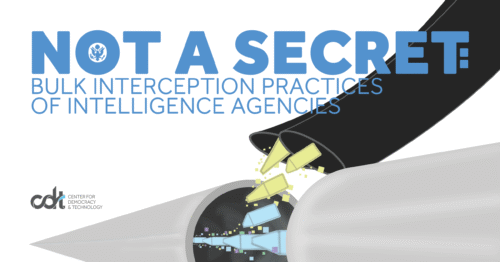
We also said so in a report we issued today, and cited in the brief, “Not a Secret: Bulk Interception Practices of Intelligence Agencies.”The report, prepared for CDT by U.K.-based surveillance expert Eric Kind, demonstrates the extent to which other countries, primarily in Europe, describe publicly and in great detail their own bulk cable interception practices.
That which the U.S. claims is a “state secret” is openly legislated about, described technically and in great detail, overseen in various forums, and challenged in various courts of U.S. surveillance partners such as the United Kingdom and Germany, and in international courts as well. Even the techniques used to select for interception particular cables, fibers in cables, and communications channels in those cables, are described.
It’s time for the U.S. to catch up by being more open about its bulk surveillance practices. While there have been some increases in surveillance transparency in recent years, far too much information is shrouded by the government’s state secrets claims. We’re hopeful that the Ninth Circuit will give transparency efforts a push in the right direction with a determination that the Jewel plaintiffs will not be denied their day in court based on the government’s secrecy claims.
British Public Oppose Secret Surveillance Powers and Want Strong Protections for Encrypted Communications
CDT released nationally representative polling data revealing that a the British public are broadly concerned about the security, privacy, and free speech consequences of allowing law enforcement to access encrypted communications.
Responding to the EU-US Negotiations on Reciprocal Data Exchanges for Border Procedures
CDT Europe, together with 29 other civil society organisations and academics, sent an open joint letter to the Council of the EU regarding the worrying direction taken by the European Commission in the EU-US border negotiations with the U.S. government.
Open Joint Letter on a Public Reassessment of the EU-US Adequacy Decision
On 29 June, the US Supreme Court ruled that US President Trump can remove the leaders of independent agencies and commissions, overturning nearly 90 years of precedent limiting executive power. This decision raises serious questions about one of the key safeguards underpinning the EU-US Data Privacy Framework adopted in 2023: independent supervision.
Return of Mass Scanning of Private Communications through Undemocratic Procedure
CDT Europe responds to the European Parliament's vote to revive the interim derogation from the ePrivacy Directive, commonly known as “Chat Control 1.0”, which provides the legal basis for the voluntary, indiscriminate scanning of private communications for known and new Child Sexual Abuse Material (CSAM), and for the solicitation of children.