The Foreign Intelligence Surveillance Act (FISA) governs electronic surveillance and physical searches conducted by the U.S. government to collect foreign intelligence information. CDT works to protect the privacy rights that this surveillance can compromise.
In 2008, Congress amended FISA to add Section 702 to authorize warrantless surveillance. CDT is working to end the abuse of this surveillance authority.
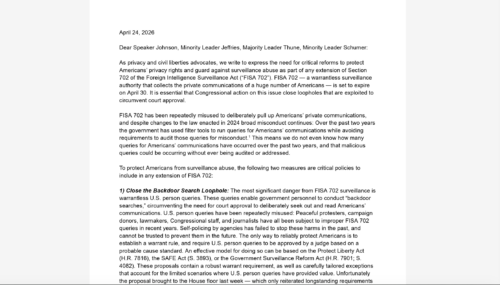
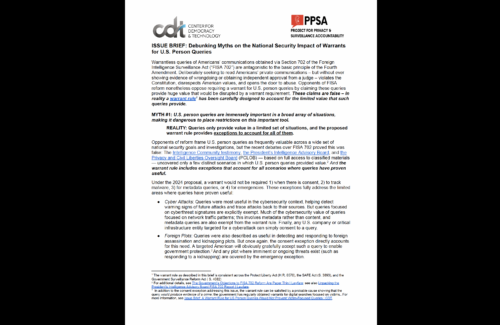
Under FISA 702, the U.S. government compels U.S. companies to disclose the contents of the communications of people who are believed to be non-U.S. persons outside the U.S. Because no warrant is required and because the U.S. government does not sufficiently account for the human rights of people outside the U.S., hundreds of thousands of people are targeted for this surveillance every year. When Americans communicate with FISA 702 targets, the Americans’ communications are also swept into this dragnet. CDT urges Congress to narrow the scope of this surveillance to people and entities who impose a real risk, and to require the government to get a warrant when it queries FISA 702 data for the communications of Americans.
CDT also works to ensure that intelligence surveillance is subjected to independent oversight so this power is not abused. The ability of Congress, inspectors general and the U.S. Privacy and Civil Liberties Oversight Board (PCLOB) to conduct this oversight has been weakened by secrecy and by political concerns, and should be made more robust. The advent of AI and its use for national security purposes makes oversight reform an urgent need.
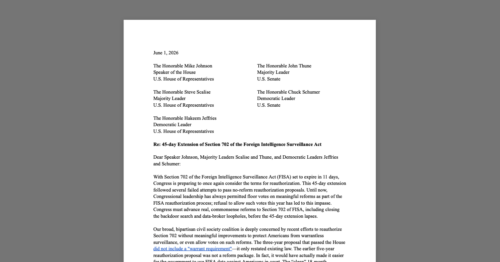
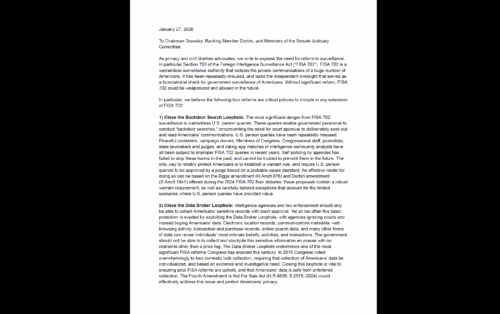
CDT Joins Letter and Calls on Senate Judiciary and Homeland Security Committee to Close the Data Broker Loophole
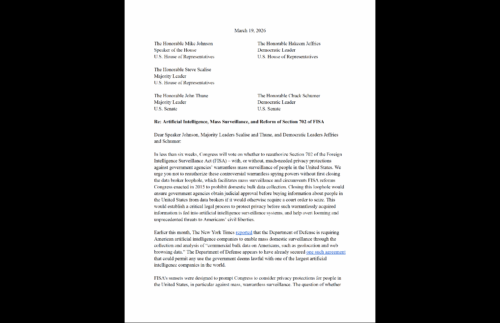
CDT called on Senate leaders to highlight a new multi-year agreement between the Department of Homeland Security and Thomson Reuters for access to Americans’ sensitive data, calling on Congress to close the data broker loophole.