This is the October 2020 recap issue of CDT’s monthly EU Tech Policy Brief. It highlights some of the most pressing technology and internet policy matters under debate in Europe, the U.S., and internationally, and gives CDT’s perspective on them.
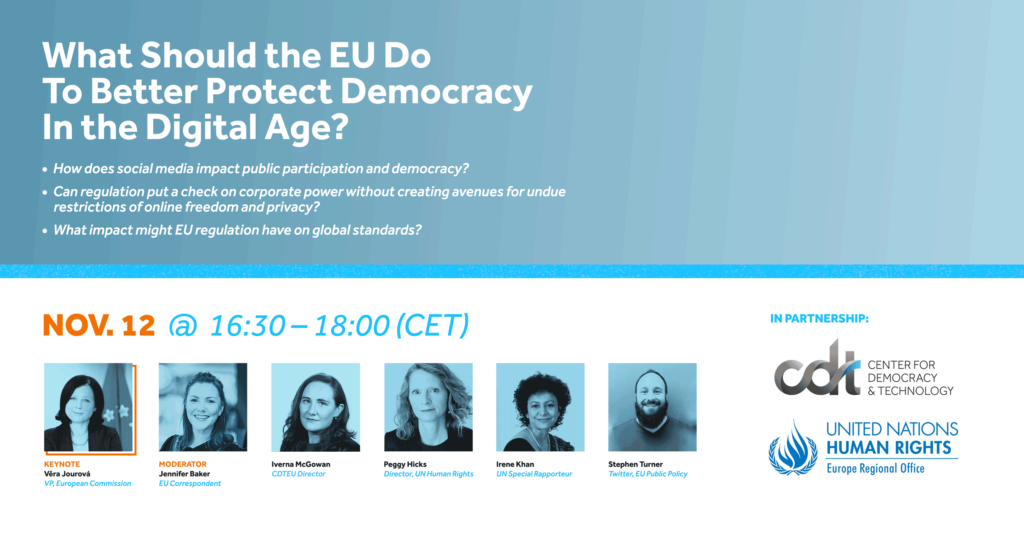
Thursday: ‘What should the EU do to better protect democracy in the digital age?’
On 12 November, the Centre for Democracy & Technology Europe and the UN Human Rights Regional Office for Europe will jointly hold a high-level online panel discussion on the need to ensure that international human rights law is at the core of the European Democracy Action Plan and the Digital Services Act. The event brings together high-level speakers, including Věra Jourová, the Vice-President of the European Commission and Commissioner for Values and Transparency, and Irene Khan, the UN Special Rapporteur on Freedom of Expression, to talk about how upcoming EU legislation could help better protect European democracy. To view the full list of speakers and register for the event, click here.
CDTEU event, “What Should the EU Do to Better Protect Democracy in the Digital Age?”, on November 12, 2020, from 16:30 – 18:00 PM CET. Link to register.
CDT Europe comments on the European Parliament’s IMCO, JURI, and LIBE Digital Services Act reports
On October 20, the European Parliament adopted three reports on the topic of the Digital Services Act (DSA). The reports represent an important step forward in the debate over what the DSA will look like, receiving support by the majority of voters and indicating a strong interest in dealing with the contemporary challenges linked to digital services. The rapporteurs are MEPs Alex Agius Saliba, Tiemo Wölken and Kris Peeters in the IMCO, JURI and LIBE committees, respectively. The first two reports were adopted as a “legislative initiative procedure”, meaning that the European Commission will need to take them into consideration in its forthcoming legislative DSA proposal. “The Parliament is lending its support to crucial free expression safeguards such as recommending a binding notice-and-action framework, maintaining a ban on general monitoring of users, and calling to allow people to have stronger control over the use of their data,” said Iverna McGowan, Director of CDT’s Europe Office, in response to the vote. For more information, read our related press release.
CDT joins civil society open letter on defending privacy while preventing criminal acts
CDT partnered with other civil society organizations on a letter to the European Commission reminding it to protect fundamental rights such as privacy and free expression, as it pursues initiatives to address crimes including the spread of child sexual abuse material (CSAM). The letter stresses that the signatories share the Commission’s goal to protect children. Child sexual abuse is a serious crime with extremely serious consequences for victims, and all its online and offline forms must be effectively eliminated. The letter argues that effective measures to achieve that goal may be found outside of technology, ranging from public education and victim support to improved cross-border police cooperation. Among other things, the letter calls on the Commission to reject recommendations in a “Technical Solutions” paper submitted to the Commission to help it form a policy response to the spread of CSAM on communications services encrypted end-to-end. It points out that short-listed “solutions” giving law enforcement officials exceptional access to encrypted content are fundamentally at odds with the essential feature of end-to-end encryption, which is that only the sender and the recipient can access the content.
CDT publishes new report addressing the use of AI in benefits determinations
CDT Europe Director, Iverna McGowan, speaks at the EU Security Summit
Iverna McGowan spoke at the EU Security Summit on a panel which showcased the Global Encryption Coalition (GEC). Encryption safeguards the personal security of billions of people and the national security of nations around the world. The Global Encryption Coalition promotes and defends encryption in key countries and multilateral gatherings where it is under threat. CDT Europe recalled the importance that encryption plays in safeguarding human rights defenders and investigative journalists.
Join us in December for the fourth annual Future of Speech Online event
Who do encryption technologies protect, why are these technologies under threat, and what does an internet with human rights and secure communication at its core look like? At the fourth annual Future of Speech Online event, held virtually this year in light of the ongoing COVID-19 pandemic, we will explore key technical concepts in the encryption policy debates, the encrypted communications tools that underpin social movements and the work of journalists, and possible approaches to moderating content in end-to-end encrypted systems. We will also discuss the implications of restrictive national anti-encryption laws for the open, global internet, and the myriad protections that secure communications technologies provide. Each day the week of December 7, we will host a session on a different topic from 11:00 am-12:00 pm ET. To register or see more information on speakers, click here.
Op-Ed: France’s Constitutional Council Ruling Tests the Limits of Social Media Bans
Read our analysis the legal and policy significance of the Constitutional Council’s decision on ongoing social media age restriction and age assurance debates ahead of the most-anticipated EU-wide approach on child online safety due by December 2026.
British Public Oppose Secret Surveillance Powers and Want Strong Protections for Encrypted Communications
CDT released nationally representative polling data revealing that a the British public are broadly concerned about the security, privacy, and free speech consequences of allowing law enforcement to access encrypted communications.
Silenced by Design: Gendered Disinformation and its Threat to Democracy
Our latest paper on gendered disinformation and the EU’s response to this growing democratic challenge is part of our TFGBV series. It explores how existing legislation can be leveraged to tackle gendered disinformation, where the current framework falls short, and what policymakers should do next.
CDT Europe’s Response to the Trusted Flaggers Guidelines Consultation
CDT Europe welcomes the opportunity to respond to the Trusted Flaggers Guidelines public consultation and to reiterate the value of an effectively functioning trusted flagger mechanism in advancing the DSA’s enforcement.