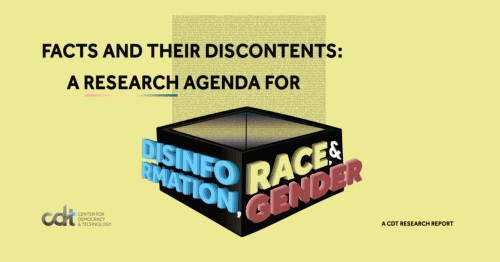
CDT Research Report Aims to Address Knowledge Gap at Intersection of Disinformation, Race, and Gender
At CDT, we’ve been thinking a lot about the research gaps when it comes to disinformation. We recognize that many disinformation campaigns are specifically designed with racist and/or misogynistic content. Some civil society groups have already engaged in work to understand and address the impacts of mis- and disinformation on communities of color and across gender identity. Unfortunately, there is still not a lot of scholarship among many traditional research organizations (e.g., universities, think tanks, policy centers, etc.) that looks at patterns and impacts on people of color, women, LGBTQIA+ communities, and other voices that are less prominent in mainstream political discourse in the U.S.
That’s why we are publishing a new report that identifies key research opportunities, including important unresolved questions around the intersections of online disinformation, race, and gender. It also makes recommendations for how to tackle the related methodological and technical problems that researchers and others face in addressing these topics.
This report is based in part on a meeting we convened in September that brought together an interdisciplinary and international group of more than 30 experts to share and discuss their research on this issue, including: Gabrielle Bardell, Principal, Herizon Democracy and Research Fellow, Centre for International Policy Studies (CIPS), University of Ottawa; Deen Freelon, Associate Professor, School of Media and Journalism, University of North Carolina at Chapel Hill; Lucina Di Meco, Women’s Political Participation Expert; Mutale Nkonde, Founder AI for the People: Faculty Fellow, Institute for Advanced Study, University of Notre Dame; Saiph Savage, Assistant Professor, Department of Computer Science and Electrical Engineering, West Virginia University; and Kristina Wilfore, Lecturer, Elliott School of International Affairs, George Washington University.
As the problem of mis- and disinformation has dominated public policy debates, including how to address the impacts on elections in the U.S. and the EU, CDT recently released guidance for election officials on how to identify and address the link between mis- and disinformation and voter suppression, and helped develop a training course for election officials on “Combating Election Misinformation.”
This new report on disinformation aims to go a step further, asking, “How can we better measure the degree and methods of coordination between different actors who may be involved in a disinformation campaign and to what extent is coordination maintained through shared views of patriarchy and/or white supremacy?”
We also seek to discover how research can better capture and understand the fluidity between misinformation and disinformation, particularly if these patterns vary across and within groups based on race, gender, and other factors.
It turns out, there’s a knowledge gap at the intersection of disinformation, race, and gender. The field may be missing a key point of disinformation campaigns, which are sometimes intentionally designed to exploit existing forms of discrimination and often target people based on race, gender identity, or both.
The stakes are too high to ignore the impacts on our society as a whole, along with the communities that, together, comprise more than half the U.S. population. And even though we have many different policy and technical proposals being put forward now to address mis- and disinformation, without the comprehensive kinds of evidence we call for in this report, these proposals may fall short and could even harm the communities they aim to protect.
It’s essential to close this knowledge gap and begin building a body of research to identify and understand the relationship between disinformation, racism, and gender. Only then can the policy community be equipped to develop solutions to mitigate the harm disinformation inflicts on U.S. democratic institutions.
Not All Guardrails Are Created Equal: Comparing Content Safety and Copyright Filtering
As courts and policymakers work through questions about chatbot liability, they should be wary of analogies that flatten meaningful technical differences. Copyright filtering and safety intervention share real challenges around ambiguity and evasion, but they diverge in what each control must assess, how each manifests over the course of a conversation, and how much can be verified from the outside.
Op-Ed: France’s Constitutional Council Ruling Tests the Limits of Social Media Bans
Read our analysis the legal and policy significance of the Constitutional Council’s decision on ongoing social media age restriction and age assurance debates ahead of the most-anticipated EU-wide approach on child online safety due by December 2026.
The brief explains that Section 230’s liability protections are essential to enable free expression online and they extend to the use of automated systems to engage to rank and order content as part of traditional publishing activities.