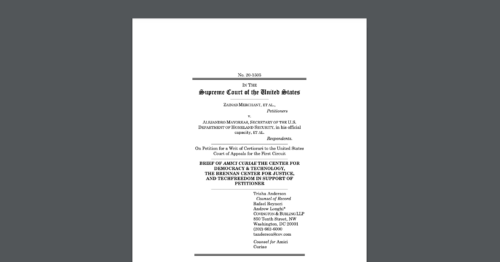
TechFreedom & Brennan Center Join CDT in Urging Supreme Court to Protect Privacy at the Border in Merchant v. Mayorkas
The Center for Democracy is urging the Supreme Court to determine whether Customs and Border Protection officials can search cell phones, computers, and other digital devices of travelers who cross the U.S. border, even when those officials have no suspicion that the device contains digital contraband.
Joined by TechFreedom and the Brennan Center, our amicus brief in support of the petition for certiorari in Merchant v. Mayorkas argues that a warrant should be required because such searches can reveal a wealth of information about the traveler and the traveler’s activities and associations. In earlier proceedings, this case was captioned Alasaad v. Wolf, and CDT filed a previous amicus brief with the First Circuit Court of Appeals in favor the plaintiffs.
CDT-led Coalition Calls for Transparency for White House AI Framework
CDT and Americans for Responsible Innovation led a broad, bipartisan coalition of over two dozen civil society groups in calling on the White House to release its Framework for review of frontier AI models.
CDT Amicus Brief Calls on Fourth Circuit to Rein In Geofence Warrants
Earlier this year the Supreme Court ruled in Chatrie v United States that the Fourth Amendment protected all cell phone location information, which CDT lauded as a landmark decision, but sent the case back down to the Fourth Circuit to assess the propriety of the geofence warrant at issue.
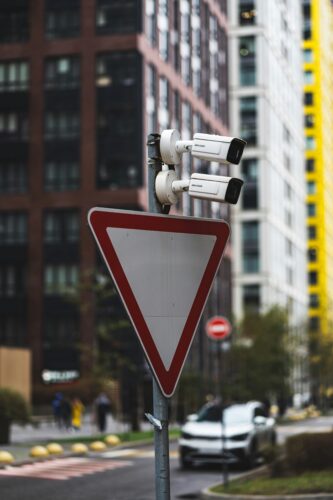
CDT and Partners Post Floor Alert Opposing CA SB 1013 Automated License Plate Readers Bill
The best way to ensure that Automated License Plate Readers are not abused is to limit the retention of stored data and to keep loopholes to lawful process closed. CA SB 1013 is a step in the wrong direction, and we urge the California legislature to reject this approach.
British Public Oppose Secret Surveillance Powers and Want Strong Protections for Encrypted Communications
CDT released nationally representative polling data revealing that a the British public are broadly concerned about the security, privacy, and free speech consequences of allowing law enforcement to access encrypted communications.