A Fork In the Road for the Fourth Amendment: How the Chatrie Case Could Shape Location Surveillance and Reverse Warrants for the Digital Age
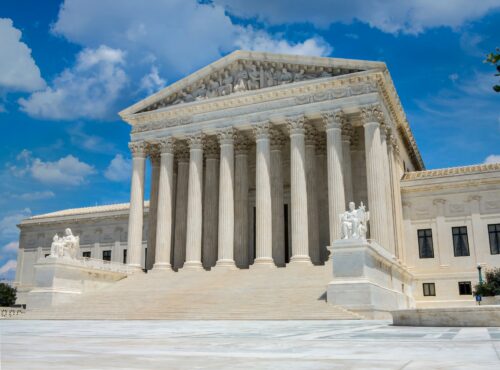
On April 27, the Supreme Court will hear oral arguments in Chatrie v United States, a case focused on surveillance conducted with geofence warrants. Privacy advocates including CDT — which submitted an amicus brief in the case — are following this case closely. The ruling is likely to have profound ramifications on the extent to which the Fourth Amendment shields the public from pervasive location tracking and a variety of other dangerous digital dragnets.
Background
Police have long used cellphone location data to track suspects, and in the 2018 case Carpenter v United States, the Supreme Court ruled that a warrant was required to electronically track a person for a week or longer. (The Court did not rule on whether a warrant was required for shorter periods.) But rather than track the movements of an individual suspect, geofence warrants focus on a time and place. They compel disclosure of location data on every phone present in the geofenced area during the period of time specified in the warrant. The size of these geofences can vary significantly, ranging from the building where a crime occurred to areas covering multiple square miles.
In the last decade, geofence warrants have exploded in number. Google — the primary known recipient — received its first geofence warrant demand in 2016. By 2018 it received nearly 1000 warrants. By 2020, that figure had surged to over 11,000 in a single year. And between 2021 and 2023 geofence warrants made up over a quarter of all law enforcement demands the company received from U.S. law enforcement. At the end of 2023, Google announced a shift in its data retention practices that ended its ability to provide responsive data for geofence warrants. Despite this, geofence warrants remain a highly relevant issue as more and more applications and digital services utilize location data.
In the Chatrie case, police served Google with a geofence warrant to investigate a bank robbery. The geofence encompassed roughly 17.5 acres, stretching far beyond the building where the crime occurred and encompassing private residences and a church. The geofence’s duration was one hour initially, but was later expanded to two hours.[1]
The district court ruled that the geofence warrant violated the Fourth Amendment, but on appeal the Fourth Circuit rendered a split decision. Seven judges stated that there was no reasonable expectation of privacy in two hours of location data held by Google (and thus no search requiring a warrant), while seven concluded that a search had occurred, though all but one of those judges upheld the warrant based on the good-faith exception to the warrant requirement. Meanwhile, the Fifth Circuit ruled in 2024 that geofence warrants are inherently overbroad and violate the Fourth Amendment, creating a circuit split that the Supreme Court will now resolve.
This case raises a pair of critical threshold questions on location privacy
Before examining the risks geofence warrants pose as a dragnet, this case requires taking on two critical, threshold questions about the Fourth Amendment and location tracking.
First, does the Fourth Amendment protect against location surveillance for a shorter period of time than the one-week period established in Carpenter? The Carpenter Court was concerned that tracking someone for a week or more would inevitably result in surveillance of intimate activities. But this danger is even more acute for geofence warrants, even for short periods of time, because the government can hone in on sensitive locations and activities to surveil: Rather than following someone and eventually happening upon sensitive activities (like visiting a church, meeting with a psychiatrist, or marching in a protest), these warrants can directly target them.
Google’s amicus brief shows how. One geofence warrant encompassed “numerous places of worship, at least two hospitals, and countless other sensitive locations.” Another covered “over a thousand people attending a funeral service.” And as CDT highlighted in its own brief, geofence warrants encompassed civil rights protests in Minneapolis and Kenosha. It is clear that when focused at sensitive locations, surveillance of far less than a week can still be highly revealing and should still trigger Fourth Amendment protections.
A second critical question is whether Fourth Amendment protections apply to location data derived from apps and digital services. In Carpenter, the Court ruled that the third party doctrine — which generally holds that individuals do not retain Fourth Amendment rights in information they voluntarily hand over to third parties — did not apply to cellphone location tracking. According to the Court, because cellphones have become indispensable to modern life, and because generating location data (specifically cellsite location information, “CSLI”) is necessary for cellphones to function, individuals could not be expected to prevent their location data from ending up in the hands of third parties. But in geofence warrant cases, the surveillance is based not on CSLI but rather location data collected and stored by providers of digital services (such as Google’s Location History services) that users opt into. That raises the question: Despite using these digital services appearing to be more “voluntary” than use of a cellphone itself, should the Court override the third party doctrine for them as well?
We believe the answer is yes, and that it is the only way for privacy rights to meaningfully survive in the digital age. A vast array of digital services and apps associated with those services rely on location data: Hailing ride-shares, recovering lost devices, connecting with nearby individuals on dating apps, navigating a route to walk through an unfamiliar neighborhood, estimating travel times and keeping apprised of traffic, logging of visits to favorite bars and restaurants, and finding a meeting point for a group at a large event all rely on location data. In the aggregate, these are not freely cast-off conveniences; they have become basic components of daily life in a digital world. Individuals shouldn’t be expected to forfeit their Fourth Amendment rights by using these services.
Equally dangerous is the notion that the third party doctrine should override Fourth Amendment protections unless users select apps, services, and settings that prevent companies from collecting and retaining location data. As CDT highlights in its brief, there are myriad reasons why this cannot be reasonably expected of the average person. It’s often unclear what data apps are even collecting. Privacy policies can be extremely difficult to understand. Whether users need to affirmatively opt out of data collection varies across services. Opt outs are not consistently honored. Changes to app settings and data policies make understanding and responding to available options even harder. To truly minimize data collection, to readily respond whenever an app’s policies and user options change, and to do so across all apps and services that collect location data would be a herculean task. Treating failure to do so as a “voluntary” choice to hand over one’s data rather than an inevitable feature of modern society (especially in a society that lacks comprehensive privacy laws) would be a huge mistake.
As dragnets, geofence warrants raise serious particularity concerns
The Fourth Amendment requires that warrants be founded on probable cause of wrongdoing, and particularity in identifying the place to be searched and the person or things to be seized. Geofence warrants clash with these requirements. They do not focus on a specific individual suspected of wrongdoing. Instead, they pull in a group of individuals, essentially treating proximity to a crime scene as guilt by association. Geofence warrants are almost never sufficiently narrow to satisfy the Fourth Amendment’s particularity requirement. And the warrant at issue in Chatrie — which pulled in dozens of individuals across a large area — certainly does not meet this standard.
As dragnets that can identify who was at highly sensitive locations, geofence warrants create acute risks of abuse. There are multiple documented geofence warrants sweeping in protesters. One geofence warrant Google received “covered several search areas for a combined 2.5 square miles of San Francisco for a cumulative period of two-and-a-half days,” while another “sought data from seven search areas spanning 489 acres in Albuquerque, New Mexico.” One “requested a search of 330 acres of suburban Wisconsin, encompassing single family homes, major roadways, schools, churches, parks, banks, and restaurants,” and another “for 25 square miles over Vail and Aspen, Colorado — sweeping in hundreds of homes, nearly 80 hotels, numerous places of worship, at least two hospitals, and countless other sensitive locations.” And of the 3000+ geofence warrants to which Google objected over the past 4 years, for over 2500 police did not respond, abandoning the warrant rather than defending it in court. That is a shockingly high proportion, and suggests that many geofence warrants are little more than fishing expeditions.
If the Supreme Court were to authorize geofence warrants under permissive standards, police could weaponize them to surveil sensitive locations and activities based on mere presence near a crime scene. This could have immense chilling effects. If individuals worry that their presence at a protest or religious service can be monitored simply if someone else nearby engaged in misconduct, people will be afraid to participate. That fear is not compatible with a free and democratic society.
The “three-step” process employed for many geofence warrants (including in Chatrie) does little to remedy these problems. In fact, despite being framed as a narrowing tool, it may make the privacy harms even more severe. Step two expands the surveillance, which threatens to pull in more highly sensitive locations even if they were not included in the geofence itself. It also undercuts the value of keeping users anonymized until step three; by tracking movements across a broader area, it becomes possible to reverse engineer identity, such as by following a phone to its owner’s home. Moreover, many geofences themselves encompass broad areas and locations such as private residences that can be used to unmask identities. Even at step three, there is no assurance that the Fourth Amendment’s particularity requirement will be met. For example, the final step of the geofence warrant at issue in Chatrie did not ask to deanonymize a particular suspect, but rather multiple individuals. And because the three-step process offers no guarantee that the final list of deanonymized phones is limited to persons for whom there is genuine probable cause of wrongdoing, it does little to stop the chilling effects geofence warrants could cause.
This case risks opening the door to a world of reverse warrants
Chatrie could also have major implications beyond location privacy. Geofence warrants have been the tip of the spear for an emerging class of “reverse warrants” that use digital technologies to invert the Fourth Amendment. Rather than directing searches at a suspect based on evidence, these reverse warrants collect information on many people in order to find a suspect. If the Court issues a broad ruling in support of geofence warrants, it could pave the way for many other types of digital dragnets.
One prominent form of reverse warrants are reverse keyword warrants, where instead of seeking details on the web searches conducted by a specific suspect, the government demands the identity of everyone who searched for certain terms. Reverse warrants are also applied to web browsing to identify everyone who visited a certain webpage. Reverse warrants are even creeping into surveillance of AI chatbots: last fall DHS served OpenAI with a warrant demanding identifying information on a ChatGPT user who entered certain prompts. Large Language Models are often used for internal musings and to bounce ideas off a wall; allowing the government to demand information on who entered certain prompts into a chatbot could essentially create a Thought Police.
Absent strong checks, it’s easy to imagine how reverse warrants could be abused. A reverse web browsing warrant could build a list of everyone who visited a website for organizing a protest (the Department of Justice actually attempted this in President Trump’s first term, demanding data on everyone who visited a website organizing 2017 inauguration day protests). Reverse keyword searches and warrants for chatbot prompts could similarly be used to unmask political, religious, or medical information, along with other highly personal activities.
The dangers of reverse warrants and content-based collection — searches centered on what a person is reading, watching, asking, or even thinking — are severe. They threaten privacy absent individualized evidence of wrongdoing, and could chill not only individuals’ activities, movements, and associations, but also individuals’ basic intellectual curiosity.
***
Chatrie could be a fork in the road for Fourth Amendment rights and privacy in the digital age. A strong ruling upholding Fourth Amendment rights could allow the public to freely use various apps and digital services, confident that even if those systems collect data, crucial safeguards from government surveillance persist. Individuals who venture into sensitive locations like protests and houses of worship could be confident their participation cannot be cataloged through sweeping geofence warrants. But a ruling against Fourth Amendment rights threatens to undo basic safeguards for the privacy of our activities and associations, making the threat of surveillance the price of services that have become a basic feature of daily life in the modern digital world. Such a ruling could usher in an age of General Warrants 2.0, in which the government could conduct mass searches absent individualized suspicion by building dragnets for various forms of digital information.
The ramifications are enormous, and will only grow as digital services and online tools become even more integrated into people’s daily lives. The Supreme Court should recognize this, and issue a ruling that will protect our privacy rights and our democracy for the digital age.
Footnotes [1] Like many geofence warrants, this order involved a three-step process that pulls in additional data over a longer span of time: In step one, police demand anonymized data on all phones within the geofence. In step two, police demand location data outside the original time window and geographic area for a subset of those phones. In Chatrie, the police demanded location information reflecting the full movements of phones for 30 minutes before and after the duration of the geofence. And in step three, police demand deanonymizing information for a subset of the phones tracked in step two.
CDT-led Coalition Calls for Transparency for White House AI Framework
CDT and Americans for Responsible Innovation led a broad, bipartisan coalition of over two dozen civil society groups in calling on the White House to release its Framework for review of frontier AI models.
CDT Amicus Brief Calls on Fourth Circuit to Rein In Geofence Warrants
Earlier this year the Supreme Court ruled in Chatrie v United States that the Fourth Amendment protected all cell phone location information, which CDT lauded as a landmark decision, but sent the case back down to the Fourth Circuit to assess the propriety of the geofence warrant at issue.
CDT and Partners Post Floor Alert Opposing CA SB 1013 Automated License Plate Readers Bill
The best way to ensure that Automated License Plate Readers are not abused is to limit the retention of stored data and to keep loopholes to lawful process closed. CA SB 1013 is a step in the wrong direction, and we urge the California legislature to reject this approach.
British Public Oppose Secret Surveillance Powers and Want Strong Protections for Encrypted Communications
CDT released nationally representative polling data revealing that a the British public are broadly concerned about the security, privacy, and free speech consequences of allowing law enforcement to access encrypted communications.