CDT Calls for SCOTUS to Reject Overbroad Geofence Warrant in New Amicus Brief
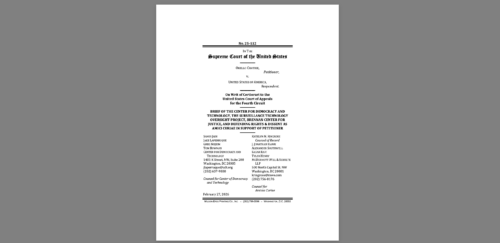
CDT, along with the Brennan Center for Justice, Defending Rights & Dissent, and the Surveillance Technology Oversight Project, is calling on the Supreme Court to reject an overbroad geofence warrant that was used to gather location data on everyone in an area. Our brief in Chatrie v. United Statesargues that electronic location data is protected by the Fourth Amendment’s warrant requirement, that the warrant in this case lacked particularity, and that approving this warrant would open the door to a panoply of problematic “reverse warrants.”
Geofence warrants authorize the government to compel a company to turn over the location data of all smartphones in a designated area for a specific period of time. The primary known recipient of geofence warrants has been Google, which until recently collected and maintained on its servers detailed information about the location of people who turn on “Location History.” The number of geofence warrants Google received grew rapidly in recent years. But at the end of 2023, Google announced a shift in its data retention practices that ended its ability to provide responsive data for geofence warrants. However, the issue remains highly relevant as more and more applications collect location information, and more and more services depend on it.
Typically, geofence warrants follow a three-step process: First, the company provides anonymized data on all phones in the area; second, for a subset of requested phones, it provides location data outside the geofence, and third, after the number of devices is narrowed further, the company provides anonymizing account information.
In this case, police served Google with a geofence warrant for the smartphones in the area around the location of a robbery. The geofence was approximately 17.5 acres in size, encompassing a large public area including a church. The geofence originally covered a one-hour period, but the warrant also included a “step two process” where location data was provided for phones for an additional hour for all movements outside the geofence area. While the District Court ruled this geofence warrant was impermissibly overbroad, a Fourth Circuit panel held that a warrant was not even required for the geofence, as there was not a reasonable expectation of privacy in the location data held by Google. The full Fourth Circuit considered the case in an en banc review, and split 7-7 as to whether a warrant was required. And at the same time this case was proceeding, a Fifth Circuit ruling held that geofence warrants are inherently overbroad and violate the Fourth Amendment, creating a circuit split.
CDT’s brief to the Supreme Court argues that the Fourth Amendment requires a warrant for use of “sense-enhancing” technologies to conduct surveillance, including electronic location tracking. It also explains that if the Court ruled that a warrant is not needed in this case because the user “volunteered” their location data to Google, there would be ripple effects on all users of services that involve data collection. Individuals could lose their Fourth Amendment rights to the information that is collected in the course of using a range of applications and services that have become engrained across modern life.
The geofence warrant at issue cast a dragnet over a large area and failed to narrow the requested data to an individual suspected of criminal wrongdoing. Our brief calls for the Supreme Court to find that it fails to meet the Fourth Amendment particularity requirement (which prohibits “general warrants” by requiring designation of a specific, reasonably limited place to be searched or the persons or things to be seized).
CDT’s brief also discusses how permitting overbroad geofence warrants would open the door to a range of “reverse warrants” that weaponize new technologies. They turn the Fourth Amendment upside down by authorizing broad surveillance to find a suspect, rather than requiring suspicion about a particular person as a prerequisite for surveillance. Our brief details several types of reverse warrants, such as searches for everyone who ran a web search using certain terms, watched a specific video online, or issued a prompt to an AI chatbot. Our brief emphasizes the dangers of allowing this new class of reverse warrants to proliferate, with significant chilling effects on free expression, research, and even basic personal thought.
CDT-led Coalition Calls for Transparency for White House AI Framework
CDT and Americans for Responsible Innovation led a broad, bipartisan coalition of over two dozen civil society groups in calling on the White House to release its Framework for review of frontier AI models.
CDT Amicus Brief Calls on Fourth Circuit to Rein In Geofence Warrants
Earlier this year the Supreme Court ruled in Chatrie v United States that the Fourth Amendment protected all cell phone location information, which CDT lauded as a landmark decision, but sent the case back down to the Fourth Circuit to assess the propriety of the geofence warrant at issue.
CDT and Partners Post Floor Alert Opposing CA SB 1013 Automated License Plate Readers Bill
The best way to ensure that Automated License Plate Readers are not abused is to limit the retention of stored data and to keep loopholes to lawful process closed. CA SB 1013 is a step in the wrong direction, and we urge the California legislature to reject this approach.
British Public Oppose Secret Surveillance Powers and Want Strong Protections for Encrypted Communications
CDT released nationally representative polling data revealing that a the British public are broadly concerned about the security, privacy, and free speech consequences of allowing law enforcement to access encrypted communications.