CDT Submits Comments to OMB on Threats to Independent Research
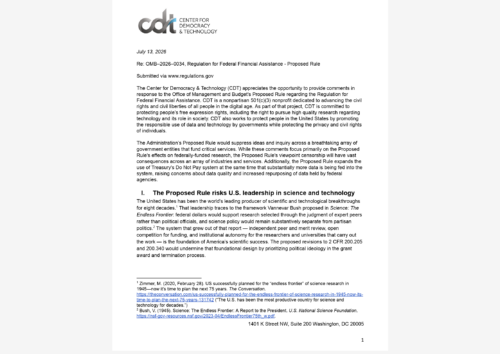
Today, CDT submitted comments opposing the Office of Management and Budget’s proposed overhaul of the rules governing federal financial assistance. The proposal would replace independent scientific judgment with political control, undermining the merit-based research system that has driven American scientific leadership for decades. While framed as an administrative update, the proposal would require agencies to prioritize projects that advance the President’s policy priorities while allowing grants to be terminated whenever those priorities change. Together, these changes would make political conformity, rather than scientific merit, the deciding factor in whether research is funded, completed, or abandoned.
Our comments explain that the proposal demands ideological allegiance as the price of eligibility to conduct scientific research, raising serious First Amendment concerns. The Proposed Rule would prohibit federal funding for entire categories of research, including on studies involving disparate impact liability, LGBTQ+ people, and any work the government characterizes as “anti-American.” It would also threaten research on content moderation and AI bias by treating standard empirical methods for studying online platforms and AI systems as suspect or ideological. By allowing political officials to determine which questions may be asked and which conclusions are acceptable, the Proposed Rule would leave researchers, policymakers, and the public with a less reliable body of scientific knowledge.
Our comments also urge OMB to strengthen privacy and security protections as it expands Treasury’s Do Not Pay system, warning that centralized government databases require robust safeguards to prevent data breaches, matching errors, and the wrongful denial of critical benefits.
Not All Guardrails Are Created Equal: Comparing Content Safety and Copyright Filtering
As courts and policymakers work through questions about chatbot liability, they should be wary of analogies that flatten meaningful technical differences. Copyright filtering and safety intervention share real challenges around ambiguity and evasion, but they diverge in what each control must assess, how each manifests over the course of a conversation, and how much can be verified from the outside.
Op-Ed: France’s Constitutional Council Ruling Tests the Limits of Social Media Bans
Read our analysis the legal and policy significance of the Constitutional Council’s decision on ongoing social media age restriction and age assurance debates ahead of the most-anticipated EU-wide approach on child online safety due by December 2026.
The brief explains that Section 230’s liability protections are essential to enable free expression online and they extend to the use of automated systems to engage to rank and order content as part of traditional publishing activities.