Encryption protects the privacy and security of communications and stored data. Backdoors to encryption to give law enforcement privileged access to communications content can be exploited by malicious hackers and abusive governments.
Technologists broadly agree that end-to-end encryption E2EE is one of the best tools to secure data. Nonetheless, governments around the world have proposed legislation that would compromise communications security by undermining encryption. Proposals include giving law enforcement a key to encrypted communications as well as imposing a “duty of care” on communications service providers to detect and block child sexual abuse material (CSAM) and terrorist content. To detect such information, providers must be able to access it, and that access defeats the protection promised by E2EE
Various schemes that purport to provide such access while preserving E2EE — such as client side scanning and adding a secret “ghost” participant to otherwise private chats — all create security risks. Alternatives to compromising encryption, such as the analysis of metadata and enhancing the ability of users to report objectionable content, are partial solutions, but are preferable to compromising communications security.
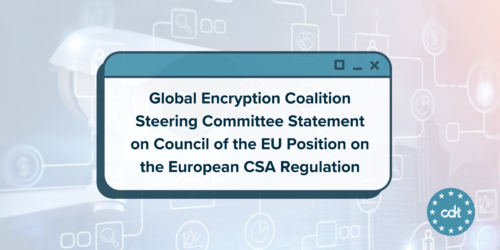
CDT Europe Feedback on the Danish Presidency’s Proposal on the Child Sexual Abuse Regulation
CDT Europe's response to the Danish Presidency of the Council of the EU's proposal to be adopted by the Council as their formal position ahead of the inter-institutional negotiations on Child Sexual Abuse Material (CSAM).