Not All Guardrails Are Created Equal: Comparing Content Safety and Copyright Filtering
As courts and policymakers work through questions about chatbot liability, they should be wary of analogies that flatten meaningful technical differences. Copyright filtering and safety intervention share real challenges around ambiguity and evasion, but they diverge in what each control must assess, how each manifests over the course of a conversation, and how much can be verified from the outside.
The norms of conversational advertising are being written right now by companies. Policy should be written alongside them, and it should start with recognizing that surreptitious manipulation at scale built on intimate information is itself a privacy harm, and a privacy law can, in part, solve some of those issue
Talking Tech with Roy Austin & Alex Givens on The Future of AI Governance
In this episode of CDT’s Tech Talks, Roy L. Austin, Jr., inaugural director of Howard University School of Law’s AI Initiative, joins Alexandra Givens, President and CEO of the Center for Democracy & Technology, to discuss the challenges and opportunities shaping the future of AI.
CDT-led Coalition Calls for Transparency for White House AI Framework
CDT and Americans for Responsible Innovation led a broad, bipartisan coalition of over two dozen civil society groups in calling on the White House to release its Framework for review of frontier AI models.
Will the Open Internet Survive the War on Bots? Mapping the Debate Over “AI Preferences”
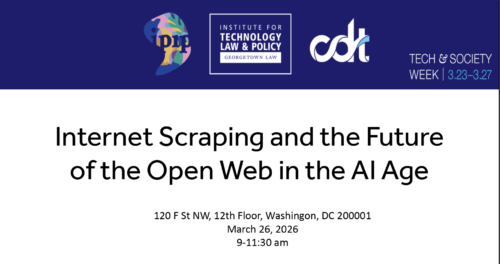
When should individuals and organizations be able to use automated tools or “bots” to collect data from or interact with openly published websites — whether we call it “scraping”, “crawling,” or simply automated data collection?
Can Generative Intermediaries Deliver When It Comes to Information Quality?
LLM-powered systems are mediating what people know and believe, the decisions they make, their ability to participate in democracy, and their ability to access trustworthy information on the issues that matter most to them.
How Policymakers Can Address AI Auditing and Assessment Requirements
As more state policymakers consider third-party AI auditing or assessment requirements, these policies face important challenges to their effectiveness.
The FTC’s proposed framework wrongly treats standard technical steps that are needed to train AI models, and ensure they are accurate, reliable, fair, and safe, as potential “deceptive steering” away from an assumed “neutral” baseline.
Assessing AI: Surveying the Spectrum of Approaches to Understanding and Auditing AI Systems
CDT's report maps the spectrum of AI assessment approaches, from narrowest to broadest and from least to most independent, to identify which approaches best serve which goals.