Not All Guardrails Are Created Equal: Comparing Content Safety and Copyright Filtering
As courts and policymakers work through questions about chatbot liability, they should be wary of analogies that flatten meaningful technical differences. Copyright filtering and safety intervention share real challenges around ambiguity and evasion, but they diverge in what each control must assess, how each manifests over the course of a conversation, and how much can be verified from the outside.
The norms of conversational advertising are being written right now by companies. Policy should be written alongside them, and it should start with recognizing that surreptitious manipulation at scale built on intimate information is itself a privacy harm, and a privacy law can, in part, solve some of those issue
Talking Tech with Roy Austin & Alex Givens on The Future of AI Governance
In this episode of CDT’s Tech Talks, Roy L. Austin, Jr., inaugural director of Howard University School of Law’s AI Initiative, joins Alexandra Givens, President and CEO of the Center for Democracy & Technology, to discuss the challenges and opportunities shaping the future of AI.
CDT-led Coalition Calls for Transparency for White House AI Framework
CDT and Americans for Responsible Innovation led a broad, bipartisan coalition of over two dozen civil society groups in calling on the White House to release its Framework for review of frontier AI models.
Tech Talks: Regulating AI in the States — From the Legislative Process to Implementation
Tech Talks takes a deep dive into the rapidly evolving landscape of state-level tech policy, reviewing how legislatures across the country are addressing the rapid deployment of artificial intelligence (AI).
What is a Database? A Technical Guide to the Personal and Institutional Considerations of Government Data Consolidation
Data consolidation must be rigorously assessed to ensure that appropriate protections are in place, the data sharing is in service of the agencies’ missions, and there are frameworks and processes in place to ensure the data is not repurposed in ways that harm the people the agencies are meant to serve.
Senate AI and Kids Safety Package Won’t Justify Preempting State AI Laws
Congress should not stifle states' work in favor of incomplete and constitutionally problematic legislative packages that create a patchwork of protections at best and erode our privacy and free expression rights at worst.
Responding to the EU-US Negotiations on Reciprocal Data Exchanges for Border Procedures
CDT Europe, together with 29 other civil society organisations and academics, sent an open joint letter to the Council of the EU regarding the worrying direction taken by the European Commission in the EU-US border negotiations with the U.S. government.
Open Joint Letter on a Public Reassessment of the EU-US Adequacy Decision
On 29 June, the US Supreme Court ruled that US President Trump can remove the leaders of independent agencies and commissions, overturning nearly 90 years of precedent limiting executive power. This decision raises serious questions about one of the key safeguards underpinning the EU-US Data Privacy Framework adopted in 2023: independent supervision.
Open Joint Letter on the AI Act Regulating AI-embedded Medical Devices
CDT Europe and other 5 organisations representing standardisation, consumers, digital rights, doctors, pharmacists and hospitals published an open joint letter calling EU policymakers to maintain medical devices under the scope of the AI Act.
Welcome back to the Centre for Democracy & Technology Europe’s Tech Policy Brief! This edition covers the most pressing technology and internet policy issues under debate in Europe and gives CDT’s perspective on the impact to digital rights. This is our last edition before the summer break, see you again in September!
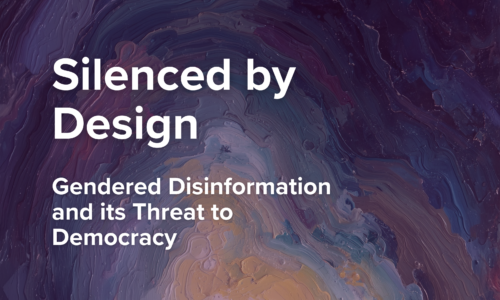
Silenced by Design: Gendered Disinformation and its Threat to Democracy
Our latest paper on gendered disinformation and the EU’s response to this growing democratic challenge is part of our TFGBV series. It explores how existing legislation can be leveraged to tackle gendered disinformation, where the current framework falls short, and what policymakers should do next.