What Do Workers Want? A CDT/Coworker Deliberative Poll on Workplace Surveillance and Datafication
This report is also authored by Wilneida Negrón and Lindsey Schwartz.
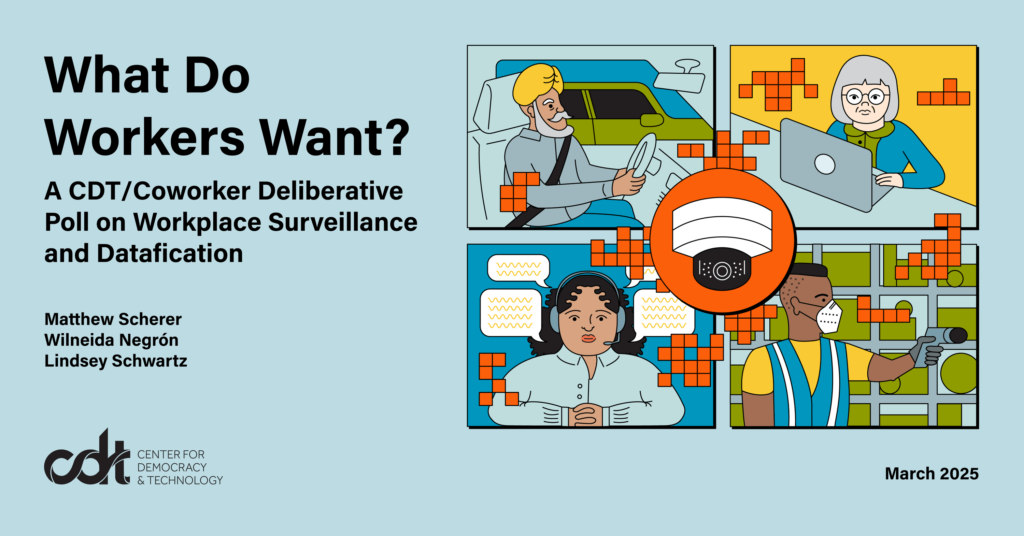
Graphic for a CDT and Coworker.org report, entitled “What Do Workers Want?” Illlustration of 4 panels of a multi-racial working class; the top left shows a bearded Sikh man driving a car; top right shows an older Asian woman on a laptop, bottom right shows a Black man holding a scanner at a packing warehouse; bottom left shows a Latina woman wearing a call center headset; a circular vignette of a security camera is at the center.
Executive Summary
In today’s rapidly evolving workplace, new technology holds the promise of increasing productivity and giving managers and employees alike improved ways to measure impact, but the proliferation of invasive monitoring and data collection—the “datafication” of workers—poses significant risks to workers’ health, safety, privacy, and rights. The Center for Democracy & Technology (CDT) and Coworker.org collaborated on a project that explored workers’ perspectives on workplace surveillance through a unique Deliberative Polling approach developed by Professor James Fishkin, founder of Stanford University’s Deliberative Democracy Lab. This process empowers workers to articulate their needs and preferences regarding workplace data collection practices by providing them with resources to educate themselves on the subject and engage each other in informed discussions about this critical issue.
The goals of this project were to:
Identify the rules and standards regarding workplace datafication that employees support when given the opportunity to learn about and discuss the topic in a neutral setting.
Assess how the deliberative process influences workers’ views and priorities regarding datafication.
Evaluate whether increased access to information and peer discussion enhances worker engagement in advocacy for their rights.
Methodology
The project employed a Deliberative Polling methodology to assess workers’ opinions on workplace surveillance. It began with a national public opinion poll of 1,800 workers to identify the types of surveillance that most concern workers (which would then serve as the topics of the Deliberative Poll) and test argument persuasiveness. This was followed by the development of policy proposals and briefing materials containing background information on each topic as well as arguments for and against each proposal. These proposals and briefing materials were refined through a pilot session with 10 workers.
The main Deliberative Poll involved 186 workers who participated in the deliberations (22 in person and 164 online), 170 of whom completed the final post-deliberation survey. The deliberations consisted of three sessions focusing on four topics: monitoring work-from-home employees, location tracking, productivity monitoring, and data rights. Participants discussed proposals in small groups and posed questions to a balanced panel of experts. The process aimed to measure both participants’ final opinions on each proposal as well as shifts in opinion resulting from their informed deliberations.
Results
In the final post-deliberation survey, respondents showed strong support for proposals that would grant workers a right to greater transparency regarding employers’ surveillance and data collection practices, prohibit off-clock surveillance, limit location tracking, and bar employers from engaging in productivity monitoring that would harm workers’ mental or physical health.
Respondents’ views appeared to shift in a number of ways between the pre- and post-deliberation surveys. After deliberations, participants became less likely to support proposals that the covered forms of surveillance should “always” or “never” be allowed and generally became more likely to support more nuanced proposals. Additionally, support for the data rights proposals and the proposals to prohibit productivity monitoring that harms workers’ mental or physical health gained significant additional support in the post-deliberation survey.
The deliberation participants also answered a series of general questions gauging participants’ sentiments and beliefs on technology and the workplace. Here too, there were noticeable shifts in the final post-deliberation survey. Specifically, after deliberations, workers expressed both greater interest and greater confidence in their ability to influence their employers’ actions — a promising finding suggesting that the very act of discussing workplace policy issues makes them better positioned to engage and organize.
Recommendations and conclusion
Moving forward, researchers should explore deliberation-centered methodologies further, both to determine workers’ organic views on key workplace policy issues and as a potential engagement and organizing tool. Policymakers should recognize the urgent need for a regulatory framework addressing the datafication of workers. By centering the voices of employees in this discourse, we can better protect their rights and foster workplaces and labor markets that promote dignity, agency, and respect.
Coalition Urges Senate Not to Let Companies Waive Financial Regulations for AI
CDT joined AI Now Institute, American Civil Liberties Union, and several organizations dedicated to tech policy, consumer protection, and civil rights in a letter to Senate leadership and the Senate Banking, Housing, and Urban Affairs Committee opposing the “AI Innovation Labs” language in Sec. 10509 of the CLARITY Act.
Potential Avenues for Redress for AI-related Harms under EU Equality and Non-Discrimination law: A Visual Explanation
In this third instalment of the series, we look at the opportunities afforded by EU equality and non-discrimination law in providing redress for AI-related harms.
CDT and Partners Urge Passage of the California Location Privacy Act of 2025 (AB 322)
Location data is particularly sensitive, and when collected across time it can reveal a broad range of intrusive insights such as medical conditions, sexual orientation, political activities, and religious beliefs.