Steps to Protect Student Privacy & Support Equity in the New School Year
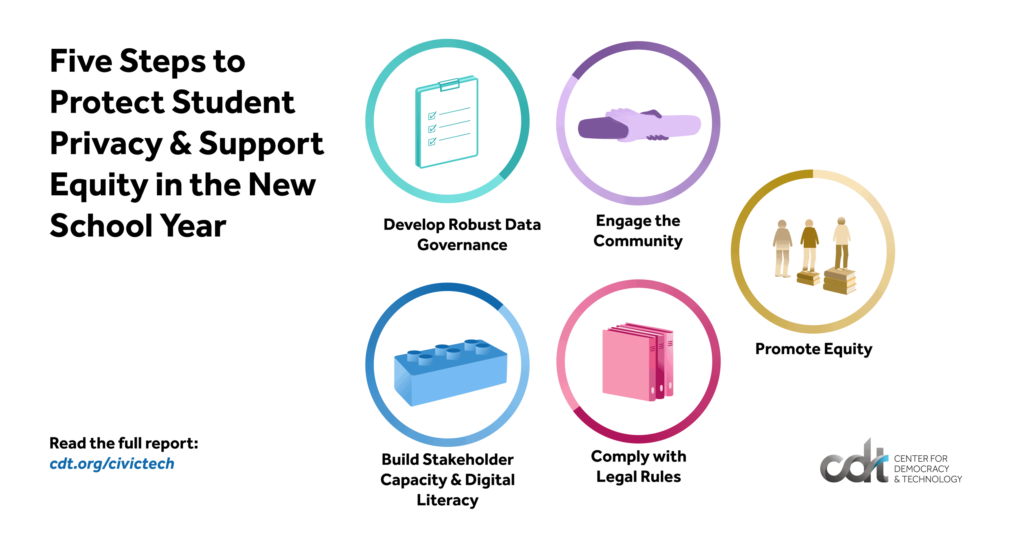
As schools return to in-person learning, education leaders will be developing processes for managing technology adopted during the pandemic and for handling new data to transition away from remote learning and reopen schools in-person. Leaders should consider five steps in implementing those processes to protect privacy and promote equity in the new school year:
Develop robust data governance
Engage the community
Promote equity
Build stakeholder capacity and digital literacy
Comply with legal rules
The return to in-person learning will likely not look and feel the same as prior to the pandemic. COVID-19 continues to present a risk to students’ and families’ health, schools are responding to renewed calls for equitable learning, and widespread distribution of devices, educational technology, and broadband connections have created new opportunities – and risks – for students, families, and educators. To help schools, families, and students navigate all of this, CDT’s Equity in Civic Technology Project is releasing an infographic and two checklists on promoting equity and protecting privacy while transitioning away from remote learning to connected in-person learning.
Coalition Urges Senate Not to Let Companies Waive Financial Regulations for AI
CDT joined AI Now Institute, American Civil Liberties Union, and several organizations dedicated to tech policy, consumer protection, and civil rights in a letter to Senate leadership and the Senate Banking, Housing, and Urban Affairs Committee opposing the “AI Innovation Labs” language in Sec. 10509 of the CLARITY Act.
British Public Oppose Secret Surveillance Powers and Want Strong Protections for Encrypted Communications
CDT released nationally representative polling data revealing that a the British public are broadly concerned about the security, privacy, and free speech consequences of allowing law enforcement to access encrypted communications.
The Privacy Paradox: How Government Data Has Become Less Private and Less Useful
Providing ready access to information collected and maintained by the government promotes accountability, innovation, and research, making transparency a core responsibility of serving as a steward of the public’s data. Public agencies must also safeguard sensitive information when making data publicly available.
Defending State Data: Lessons from California v. USDA
As the federal government increasingly seeks access to state administrative data, policymakers should consider not only legal authority and privacy implications, but also the practical effects on public confidence, program effectiveness, and states’ ability to fulfill their obligations to residents.