President Trump Should Continue Justice Scalia’s First & Fourth Amendment Legacy
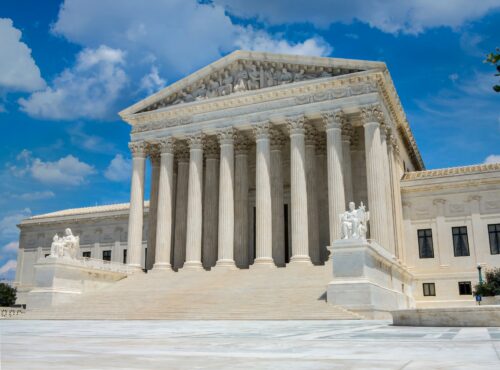
The Supreme Court has been short one justice for nearly a year, and President Trump is expected to announce a nominee for the vacant seat this week. While we do not yet know who that nominee will be, the President has repeatedly promised to fill the vacancy with a justice “very much” like the late Justice Antonin Scalia. While I personally take issue with much of Justice Scalia’s jurisprudence through the years, there is no disputing that he was a strong supporter of the First and Fourth Amendments, and the person appointed to take his seat should be the same.
Justice Scalia was a fierce defender of Americans’ right to privacy. He believed that the sanctity of a person’s home and property was to be held above the governmental interests in fighting crime. For example, he wrote the majority opinion in Kyllo v. United States, a 5-4 ruling that barred police from peeping into a home with a thermal-imaging device. In United States v. Jones a man had his Jeep tracked with GPS devices without a warrant, leading to a drug trafficking conviction. Justice Scalia wrote the majority opinion to hold that when law enforcement officers install a digital age GPS tracker on a suspect’s car, enabling the police to constantly track the vehicle, they must first get a warrant. And Justice Scalia famously dissented in Maryland v. King, arguing that the Fourth Amendment forbids law enforcement from collecting DNA from arrestees and predicting that as a consequence of the majority’s decision, “your DNA can be taken and entered into a national DNA database if you are ever arrested, rightly or wrongly, and for whatever reason.”
In the First Amendment realm, Justice Scalia cast a decisive 5-4 vote in one of the most important free speech case of the 1980s, Texas v. Johnson, which held that flag burning qualified as constitutionally protected expression. He did this despite his personal distaste for flag burners: “If it were up to me, I would put in jail every sandal-wearing, scruffy-bearded weirdo who burns the American flag. But I am not king.” Similarly, he authored the majority opinion in 2011’s Brown v. Entertainment Merchants Association, a victory for First Amendment advocates. There the video-game and software industries, filed a preenforcement challenge to a California law restricting the sale or rental of violent video games to minors. Led by Scalia, the Court found video games qualify for First Amendment protection because the games – like protected books, plays, and movies – communicate ideas. Justice Scalia found “the basic principles of freedom of speech … do not vary” with a new and different communication medium.
The next justice will be asked to protect our First and Fourth Amendments in the digital context. 87% of Americans, and 99% of all 18-29 year-olds are online. Even my 97 year-old grandmother uses the internet to read the news, make political donations, and communicate with her loved ones and doctors. Almost 70% of adult Americans own a smart phone. The phones are used to message, Instagram, and tweet, as we maneuver from point A to point B. In the process, we leave data trails everywhere, with no clear legal guidance as to how that data should be protected or utilized.
In recent years, we have been grappling with an increasing morass of technology law headed to the courts: We monitor our pets, children, and homes remotely; can authorities tap into those same secure webcams and listening devices? We use voice activation to turn on virtual assistants to play music or listen to a weather forecast; can those requests be recorded and later released to the police? Upon being arrested, can you be compelled to unlock your phone with your fingerprint reader, or to provide the phone’s security code or pattern? Commuters pay their bridge and toll fees with an automated device; can the police use the same data about their driving distance and times to slap them with a speeding ticket?
Most of the law surrounding technology use has yet to be written. Many of us intuitively understand that our steadily growing mountains of online data are best viewed as an extension of our offline persona. How much privacy we are entitled to retain in our own involuntarily generated data and how much protection we receive for our speech online remains to be seen.
Americans deserve a justice who will protect their First and Fourth Amendment rights.
Coalition Urges Senate Not to Let Companies Waive Financial Regulations for AI
CDT joined AI Now Institute, American Civil Liberties Union, and several organizations dedicated to tech policy, consumer protection, and civil rights in a letter to Senate leadership and the Senate Banking, Housing, and Urban Affairs Committee opposing the “AI Innovation Labs” language in Sec. 10509 of the CLARITY Act.
Not All Guardrails Are Created Equal: Comparing Content Safety and Copyright Filtering
As courts and policymakers work through questions about chatbot liability, they should be wary of analogies that flatten meaningful technical differences. Copyright filtering and safety intervention share real challenges around ambiguity and evasion, but they diverge in what each control must assess, how each manifests over the course of a conversation, and how much can be verified from the outside.
CDT-led Coalition Calls for Transparency for White House AI Framework
CDT and Americans for Responsible Innovation led a broad, bipartisan coalition of over two dozen civil society groups in calling on the White House to release its Framework for review of frontier AI models.
CDT Amicus Brief Calls on Fourth Circuit to Rein In Geofence Warrants
Earlier this year the Supreme Court ruled in Chatrie v United States that the Fourth Amendment protected all cell phone location information, which CDT lauded as a landmark decision, but sent the case back down to the Fourth Circuit to assess the propriety of the geofence warrant at issue.