Pause, Reflect, and Redirect: Helping Youth Make Better Digital Choices
Pamela Wisniewski, Director, Socio-Technical Interaction Research (STIR) Laboratory Liz Sweigart, Adjunct Faculty, The Chicago School Aahil Valliani, Thomas Jefferson High School for Science and Technology
Disclaimer: The views expressed by CDT’s Non-Resident Fellows are their own and do not necessarily reflect the policy, position, or views of CDT.
When it comes to keeping young people safe online, many schools and parents rely on blocking and restriction. Although these tools can stop a harmful click in the moment, they rarely help youth build the decision-making skills they need for the long term. In fact, overly punitive approaches can backfire — driving risky behavior underground, cutting off access to helpful resources, and removing chances to learn from mistakes.
In our recent study, we explored a new way to intervene: Pause, Reflect, and Redirect (PRR). PRR is built on trauma-informed child psychology, behavior-change theory, and human-centered design. Rather than punishing, it prompts youth to stop, think, and try again in real time.
What is PRR?
PRR has three levels of intervention:
Casual intervention – Gentle prompts to reconsider a choice without stress or shame.
Coached intervention – Structured guidance with the option to involve a trusted adult to plan a better course of action.
Crisis intervention – Immediate redirection to a trusted adult and resources when there’s a risk of harm.
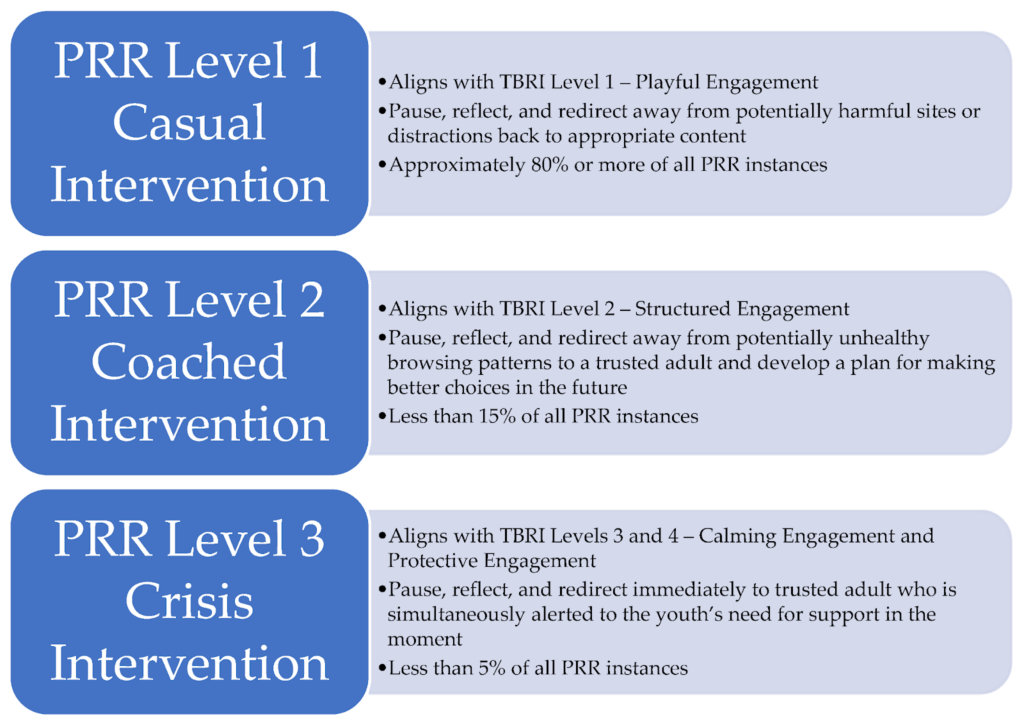
This tiered approach draws from Trust-Based Relational Intervention® (TBRI) principles, which emphasize meeting youth with the least firmness necessary to redirect behavior and offering immediate opportunities to “redo” in a supportive way. Figure 1 illustrates how the three PRR levels align with the corresponding stages of the TBRI framework.
Figure 1: Alignment of the three levels of PRR with the corresponding levels of the TBRI framework.
Bringing PRR Into the Classroom
A third-party software firm developed PRR into a web-filtering extension that was installed on Chromebooks in a public middle school (grades 6-8, ages 11-14) in an urban charter district. Students and their families were informed about the tool in advance of use and provided their consent prior to participation. Although students were offered the option to opt out of using the software, all families agreed to participate. Over five weeks, the software monitored students’ attempts to access off-topic or risky sites during school hours and responded with the appropriate PRR level. Off-topic sites included content unrelated to schoolwork, such as sports scores, gaming walk-throughs, or shopping pages. Risky or inappropriate content encompassed pornography, violent imagery, and searches related to drugs, weapons, or self-harm.
At each level, the extension offered students a different kind of intervention. Trusted adults in the study were the school’s teachers and administrators. Students were informed that a Level 3 trigger would always notify an adult. At Level 2, they could choose whether to send a message and had the option to select which teacher or administrator to contact. For Level 3 situations, such as searches related to self-harm or weapons, the alerts went directly to the principal and superintendent, as school leadership determined they were best positioned to respond immediately.
Level 1 (Casual engagement): Students saw light, low-stakes prompts (e.g., “This isn’t schoolwork, is it?” paired with an option to “Try Again”). These quick nudges encouraged them to pause and redirect without stress or shame.
Level 2 (Coached engagement): If students persisted, the system temporarily limited browsing to approved educational sites and sent a notification to a teacher or trusted adult. The student could then restore full access by working with the adult to reflect on their choices and make a plan for moving forward.
Level 3 (Crisis engagement): In rare cases involving searches linked to self-harm or violence, the system alerted a trusted adult immediately and displayed supportive resources such as a crisis hotline. This ensured that serious risks prompted timely intervention and care.
By tailoring responses to the situation, the extension turned moments of misbehavior or curiosity into teachable opportunities that helped students reflect, learn, and self-correct instead of simply being blocked or punished.
The results were encouraging:
58% reduction in attempts to access off-task or inappropriate sites.
77% of students never needed more than a Level 1 intervention.
Only one Level 3 incident, which led to a productive conversation about situational awareness and empathy — not a punishment.
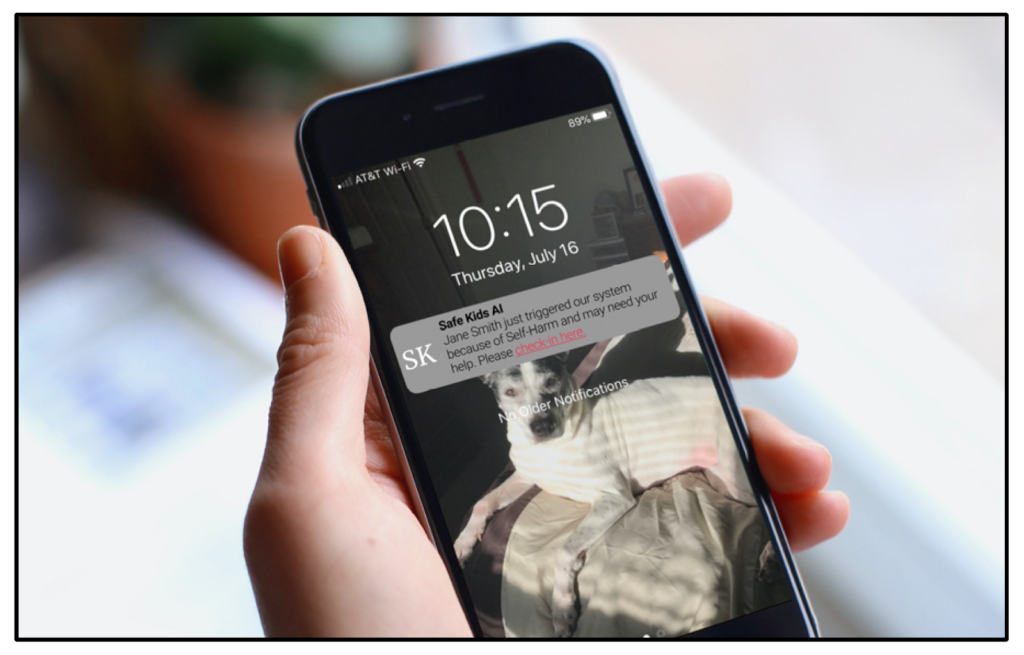
These outcomes align with TBRI’s expectation that most problematic behavior can be addressed with low-level, relationship-based interventions. Figure 2 shows a visual example of a PRR Level 3 mobile alert triggered by the detection of self-harm risk.
Figure 2: Pictorial representation of a PRR Level 3 intervention mobile device alert for detection of self-harm risk.
Why This Matters
Adolescence is a time of exploration, risk-taking, and rapid learning. If every online misstep is met with immediate restriction, students lose the chance to practice making better decisions in real time. PRR keeps youth engaged in the learning environment while supporting reflection and self-correction.
The pilot also showed that these interventions can spark meaningful conversations between students and trusted adults — shifting the focus from discipline to growth. In the Level 3 case, a student searched for information about a video game, which unexpectedly returned links to purchase the weapons featured in it. After the principal received the alert and spoke with the student, the two discussed how such a search might be misinterpreted by others. Through that conversation and self-reflection, the student recognized how what seemed to be a harmless search could make classmates feel unsafe, if taken out-of-context, and learned to be more conscientious about their search behavior going forward.
Looking Ahead
Our early findings point to several next steps:
Integrating youth voice – Co-designing interventions to ensure they are developmentally appropriate and emotionally safe.
Studying long-term effects – Understanding whether skills gained in school settings carry over to home and personal device use.
Adapting PRR for broader impact – Evolving the deployment of the framework for different school settings, age groups, and devices.
Creating safe, supportive online spaces requires more than just shutting down harmful content. It means giving youth the space — and the tools — to learn from mistakes, strengthen judgment, and build resilience.
PRR offers one path forward: real-time, developmentally aligned guidance that treats online missteps not as failures to punish, but as opportunities to grow.
This research was led by Liz Sweigart during her postdoctoral fellowship at Vanderbilt University, with contributions from Aahil Valliani, a student at Thomas Jefferson High School for Science and Technology, and conducted under the mentorship of Dr. Pamela Wisniewski—a CDT Non-resident Fellow and Director of the Socio-Technical Interaction Research Laboratory. The work received no external funding. The authors have no financial interests in the company that developed the software tested in this study, with one exception: Aahil Valliani is a teenager who became CEO of that software firm after the software had been created and tested. The firm is now an open-source initiative, and his subsequent role did not influence the study’s design, analysis, or findings. The remaining authors report no commercial or financial relationships that could be construed as potential conflicts of interest. Any opinions, findings, conclusions, or recommendations expressed are those of the authors and do not necessarily reflect the views of any affiliated organizations.