Model Policy and Infographic: Non-Consensual Intimate Imagery (NCII) for K-12 Schools
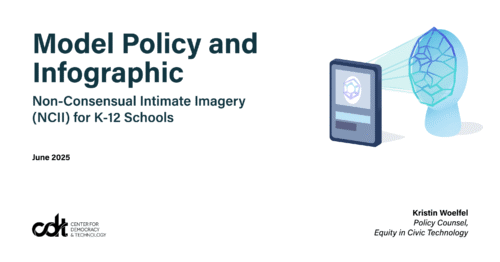
Graphic for CDT model policy and infographic, tackling Non-Consensual Intimate Imagery (NCII) for K-12 Schools. Illustration of phone scanning a young person’s face.
In 2024, the Center for Democracy & Technology (CDT) conducted surveys of public high school students and public middle and high school parents and teachers to understand the prevalence of deepfakes, NCII, and related issues in K-12 schools. These surveys showed that concerns over the widespread nature of NCII were well-founded, and that there were significant gaps in schools’ current capabilities to handle the issue. Namely, efforts to educate students about NCII, prevent the conduct, and provide support to those who have experienced NCII were sparse.
Although addressing NCII, both authentic and deepfake, will require a long-term, multistakeholder approach, CDT convened a taskforce of diverse stakeholders and advocates to create a Model NCII Policy for K-12 schools as a first step toward filling the gaps identified in our research. Specifically, the Model NCII Policy:
Outlines the offense of sharing NCII;
States the school’s role in circumstances where NCII has been shared by/of a member of the school community;
Promotes visibility of reporting mechanisms and supportive measures for those impacted by the sharing of NCII; and
Provides customizable language that schools/districts can choose to integrate the policy into existing Title IX, bullying/harassment, and/or digital citizenship policies.
CDT also created an infographic to prevent distribution of NCII and support its victims that includes tips and resources about deepfake NCII. The infographic is intended to be useful in a number of formats, whether as a poster, a hand-out, or shared in its digital format.
Coalition Urges Senate Not to Let Companies Waive Financial Regulations for AI
CDT joined AI Now Institute, American Civil Liberties Union, and several organizations dedicated to tech policy, consumer protection, and civil rights in a letter to Senate leadership and the Senate Banking, Housing, and Urban Affairs Committee opposing the “AI Innovation Labs” language in Sec. 10509 of the CLARITY Act.
As concern about risks and harms related to AI systems continue to grow, a growing chorus of policymakers, industry leaders, and advocates have called for independent AI assessments. This explainer provides an overview of recent proposals for third-party assessment in the United States, including state and federal legislation, executive actions, and industry proposals.
Having third parties assess AI systems might seem like common sense, but crafting effective policies toward this goal can be devilishly tricky. A poorly-constructed ecosystem for third-party assessment could easily fail to consider the most consequential mechanisms of risk, neglect the AI harms that most impact people, or do more to protect AI companies than people.
Not All Guardrails Are Created Equal: Comparing Content Safety and Copyright Filtering
As courts and policymakers work through questions about chatbot liability, they should be wary of analogies that flatten meaningful technical differences. Copyright filtering and safety intervention share real challenges around ambiguity and evasion, but they diverge in what each control must assess, how each manifests over the course of a conversation, and how much can be verified from the outside.