Cybersecurity Detour on the Road to Surveillance Parity
For some time, the European Commission and European Data Protection Authorities (DPAs) have complained that US law provides insufficient protection to Europeans for the data that is shared from Europe to the United States. This is important to Europeans and to people around the world who use wildly popular services based in the US, like Facebook, Gmail, and Twitter. The European Commission has made some level of parity a condition of data exchanges with the US in the criminal context, and as a result, Congress is considering the Judicial Redress Act to extend some Privacy Act protections to that data flow. Though the bill is only a small step forward, US companies have embraced it and Congress seems poised to adopt it.
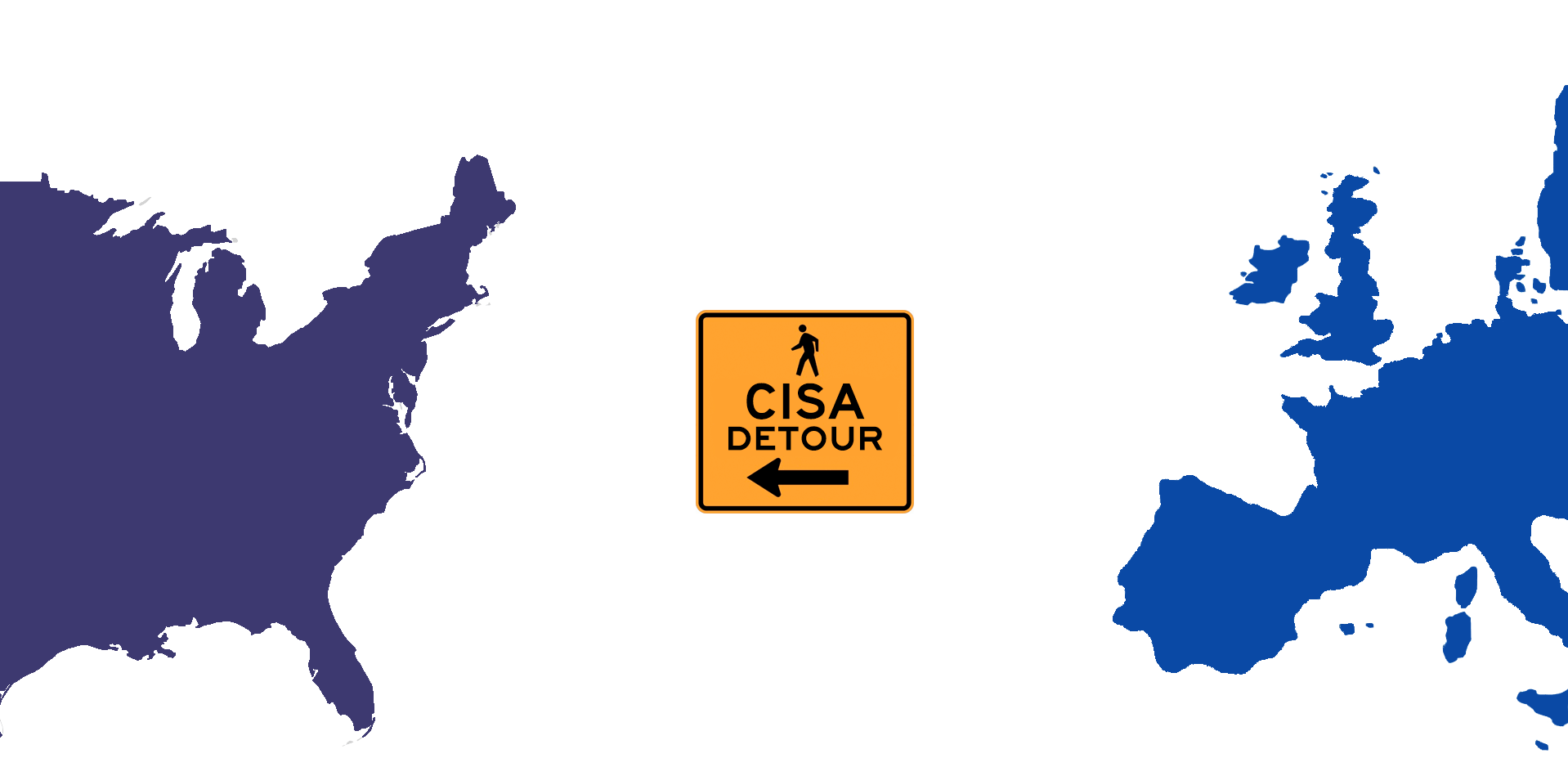
Ironically CISA would increase the gap in data protection between Europeans and Americans in US law, rather than help close it.
Ironically, different legislation that the Senate just passed, CISA, or S. 754, would increase the gap in data protection between Europeans and Americans in US law, rather than help close it. CISA permits companies to share with the Federal government “cyber threat indicators” (CTIs) derived from Internet users’ communications. It requires companies and the Federal government to remove from CTIs personally identifiable information (PII) that they know is not directly related to a cybersecurity threat. Senator Wyden (D-OR) proposed an amendment to the bill that would require notice to a person whose PII was shared inappropriately under the bill.
Instead of accepting Senator Wyden’s approach, the bill managers changed the amendment from a privacy victory for all to a privacy victory just for Americans. They made it so that non-US persons (everyone but US citizens and residents) get no notice when the Federal government shares their PII illegally under the bill, but required such notice to US persons.
Notice to the victim of a privacy abuse discourages such abuse. If it is possible to give such notice to Americans, it should be possible to give the notice to anyone whose PII is shared unlawfully. Instead of moving toward data protection parity between Europeans and Americans, the bill furthers the disparity – and it does so for no good reason.
The House cybersecurity bill includes no such disparity. Unfortunately, that is because it imposes no duty to give notice of privacy violations to anyone at all – not to Americans nor to anyone else. One can only hope that when the bills are reconciled, this will be corrected to ensure that when anyone’s personal information is shared illegally under the cybersecurity legislation, they are told about it.
CDT-led Coalition Calls for Transparency for White House AI Framework
CDT and Americans for Responsible Innovation led a broad, bipartisan coalition of over two dozen civil society groups in calling on the White House to release its Framework for review of frontier AI models.
CDT Amicus Brief Calls on Fourth Circuit to Rein In Geofence Warrants
Earlier this year the Supreme Court ruled in Chatrie v United States that the Fourth Amendment protected all cell phone location information, which CDT lauded as a landmark decision, but sent the case back down to the Fourth Circuit to assess the propriety of the geofence warrant at issue.
CDT and Partners Post Floor Alert Opposing CA SB 1013 Automated License Plate Readers Bill
The best way to ensure that Automated License Plate Readers are not abused is to limit the retention of stored data and to keep loopholes to lawful process closed. CA SB 1013 is a step in the wrong direction, and we urge the California legislature to reject this approach.
British Public Oppose Secret Surveillance Powers and Want Strong Protections for Encrypted Communications
CDT released nationally representative polling data revealing that a the British public are broadly concerned about the security, privacy, and free speech consequences of allowing law enforcement to access encrypted communications.