CDT’s Kate Ruane Testifies Before House Committee on Energy and Commerce on “Legislative Solutions to Protect Children and Teens Online”
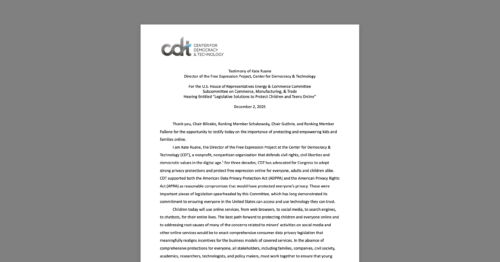
The Center for Democracy & Technology’s (CDT) Director of the Free Expression Project, Kate Ruane, is testifying on Tuesday, December 2, 2025 before the U.S. House of Representatives’ Committee on Energy and Commerce, in the Subcommittee on Commerce, Manufacturing, and Trade.
A portion of her written testimony is pasted below.
***
Children today will use online services, from web browsers, to social media, to search engines, to chatbots, for their entire lives. The best path forward to protecting children and everyone online and to addressing root causes of many of the concerns related to minors’ activities on social media and other online services would be to enact comprehensive consumer data privacy legislation that meaningfully realigns incentives for the business models of covered services. In the absence of comprehensive protections for everyone, all stakeholders, including families, companies, civil society, academics, researchers, technologists, and policy makers, must work together to ensure that young people can grow and learn to use online services in a safe and age-appropriate fashion, regardless of their race, gender, socioeconomic status, disability, or familial situation. The subcommittee is right to focus on this critical topic. Our collective future depends on it.
The efficacy of the legislation the Committee today considers further depends on the efficacy of the agency and actors entrusted to enforce the law. All of the bills under consideration task the Federal Trade Commission (FTC) with enforcement or implementation powers. The current Administration is undermining the independence of the FTC, by purporting to “fire” several independent commissioners without cause, contrary to law and the Supreme Court’s 1935 decision in Humphrey’s Executor v. United States. The current chair has even taken to calling his agency the “Trump-Vance FTC,” signifying who is really in charge. These actions threaten the FTC’s ability to enforce the law fairly, the short and long term implications of which should be of bipartisan concern. Laws without meaningful and fair enforcement mechanisms are at best just words on a page. At worst, they are political weapons that can be wielded by those who hold power against those who do not. As the Committee considers the weighty issues of protecting children online, it must also work to ensure that the agency empowered to execute its policies will do so fairly and in a manner that protects all children and supports the rule of law.
Today I’d like to raise five critical points essential to protecting children online:
Congress should address root causes of online harms including, in particular, privacy.
Protecting children includes protecting their right to express themselves online.
Age assurance and verification create significant privacy risks that should be mitigated in legislation if the government requires or incentivizes its use.
Creating good policy requires taking into account the varied perspectives and experiences of minors and their caregivers.
Congress must not unduly restrict states’ ability to act –and, in particular, must reject any false deal that conditions kids’ online safety on preempting states’ ability to regulate AI.
On September 15, 2026, the Center for Democracy & Technology and Electronic Frontier Foundation filed an amicus brief along with the Wikimedia Foundation in Meta Platforms v. Bonta, challenging California’s SB 976.
Coalition Urges Senate Not to Let Companies Waive Financial Regulations for AI
CDT joined AI Now Institute, American Civil Liberties Union, and several organizations dedicated to tech policy, consumer protection, and civil rights in a letter to Senate leadership and the Senate Banking, Housing, and Urban Affairs Committee opposing the “AI Innovation Labs” language in Sec. 10509 of the CLARITY Act.
Not All Guardrails Are Created Equal: Comparing Content Safety and Copyright Filtering
As courts and policymakers work through questions about chatbot liability, they should be wary of analogies that flatten meaningful technical differences. Copyright filtering and safety intervention share real challenges around ambiguity and evasion, but they diverge in what each control must assess, how each manifests over the course of a conversation, and how much can be verified from the outside.
Potential Avenues for Redress for AI-related Harms under EU Equality and Non-Discrimination law: A Visual Explanation
In this third instalment of the series, we look at the opportunities afforded by EU equality and non-discrimination law in providing redress for AI-related harms.