CDT’s Isabel Linzer Speaks on “Cyber Interference with Democracy” Panel: Insights from the 2025 Octopus Conference
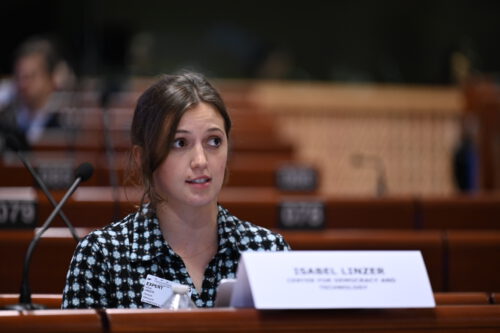
Earlier in June, CDT’s Isabel Linzer participated in the Council of Europe’s 2025 Octopus Conference on cybercrime, speaking on a panel during the session on “Cyber Interference with Democracy.”
The panel identified evolving disinformation tactics that extend beyond traditional methods that include deepfakes, AI-generated content, manipulated engagement, and hyper-specific targeted disinformation campaigns. These sophisticated approaches present rapidly evolving challenges for protecting democratic processes while maintaining fundamental rights and freedoms.
Linzer emphasized that AI has fundamentally changed politics by amplifying digital influence campaigns and prompting governments, companies, campaigns, and civil society to reshape their priorities. While measuring AI’s direct impact on voters remains empirically difficult, she noted that “we can say that it changed the electoral landscape and therefore, we need to think about the threat landscape and democracy in elections more broadly.”
Linzer then highlighted significant gaps in current regulatory frameworks, using the Telecommunications Consumer Protection Act as an example of legislation that “has a lot of loopholes” and “doesn’t have AI-specific provisions in it,” making it inadequate for addressing the full scope of modern communications. However, she cautioned that reactionary measures should be implemented carefully, as researchers have found that much AI political speech consists of satire or art created by regular people. Rather than viewing AI as an entirely new threat, Linzer characterized it as “an accelerant of existing risks.”
The discussion of state-level responses revealed both promise and concern. Over a dozen states in the US have introduced election and AI laws, including a Connecticut proposal that would “institute criminal penalties for knowingly distributing unlabeled election deepfakes.” However, such measures risk creating a “chilling effect on political discourse” by potentially suppressing regular people’s nonthreatening political messages. Linzer advocated for a more balanced approach that subjects political influencers, social media companies’ transparency efforts, and existing company policy in key areas like advertising to equal scrutiny, arguing that these traditional elements pose threats to democratic discourse that are just as serious as those from AI-generated content.
Rapporteur Summary
As rapporteur, Linzer summarized risks, challenges, and effective responses identified during the half-day session on cyber interference in democracy. She highlighted three primary concerns: the commoditization of “for-hire” cyber interference tactics makes them more accessible and scalable across different contexts; establishing clear cause and effect relationships with interference presents significant challenges, complicating time-sensitive policy and legal responses; and any response to cyber interference must carefully balance free expression and broader human rights, including freedom of assembly and association.
Despite recent backlash, media literacy and fact-checking remain crucial as social media platforms and AI developers fail to consistently meet transparency expectations. This has intensified debates over regulation versus self-regulation, highlighting the urgent need to update existing laws for digital spaces, including political advertising rules and sanctions that evolve with technology. Effective prevention requires a multi-stakeholder approach combining strengthened cybersecurity, enhanced monitoring and threat intelligence, and improved international cooperation to better enforce existing laws. Check out the full session on cyber interference in democracy here and Isabel’s rapporteur comments here.
When the Algorithmic Odds are Not in your Favor: Algorithmic Poisoning and the 2026 U.S. Midterms
As the 2026 midterms approach, policymakers, election officials, and AI developers and deployers share responsibility for understanding how algorithmic poisoning operates and taking concrete steps to reduce its impact.
A Fractured Shield: Changes to Cyber Information Sharing Put Elections at Risk
Cyber information sharing connects election security partners, empowering cyber defenders, uplifting risks to be mitigated, and fostering a common understanding of the threats and security of the community.