CDT Testimony before Pennsylvania Joint Hearing on Dynamic Pricing
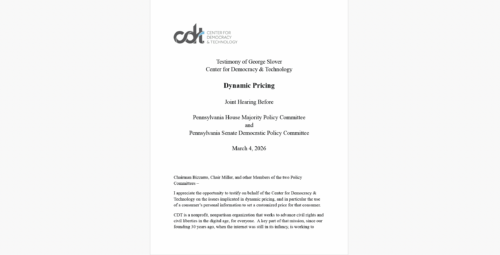
George Slover, competition policy counsel for CDT, testified at a joint hearing before the Pennsylvania Assembly’s House Majority Policy Committee and the Senate Democratic Policy Committee, on the issue of dynamic pricing.
His testimony focused primarily on one species of dynamic pricing, the more personally intrusive and abusive kind — secretly using a consumer’s personal data profile to size them up for their susceptibility to paying extra. It’s what CDT has been referring to as “bespoke pricing,” because the price is “tailor fitted” to the consumer. And like a tailor-made suit, the targeted consumer pays more.
Bespoke pricing is unfair, and it’s discriminatory. It’s Adam Smith’s “invisible hand” being turned against consumers, picking their pocket.
The technology is readily available, and is becoming easier to use and more powerful with the advance of artificial intelligence. The temptation to use it will be hard to resist. We need to rein it in before it becomes widespread, in grocery shopping and elsewhere.
Slover also addressed another type of dynamic pricing the committees are examining — the use of artificial intelligence to change prices more frequently, to perceived fluctuations in market supply and demand. He told the committee that this could have an extremely disruptive effect on family budgets if the consumer entered a store to purchase products at an advertised price only to find them on the store shelves at a higher price.
Coalition Urges Senate Not to Let Companies Waive Financial Regulations for AI
CDT joined AI Now Institute, American Civil Liberties Union, and several organizations dedicated to tech policy, consumer protection, and civil rights in a letter to Senate leadership and the Senate Banking, Housing, and Urban Affairs Committee opposing the “AI Innovation Labs” language in Sec. 10509 of the CLARITY Act.
Potential Avenues for Redress for AI-related Harms under EU Equality and Non-Discrimination law: A Visual Explanation
In this third instalment of the series, we look at the opportunities afforded by EU equality and non-discrimination law in providing redress for AI-related harms.
CDT and Partners Urge Passage of the California Location Privacy Act of 2025 (AB 322)
Location data is particularly sensitive, and when collected across time it can reveal a broad range of intrusive insights such as medical conditions, sexual orientation, political activities, and religious beliefs.