CDT Joins Letter Urging Senate to Remove Section 5934 from NDAA Prior to Passage
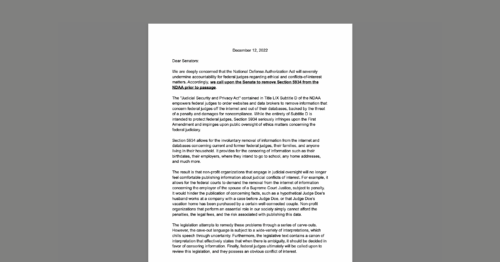
The Center for Democracy & Technology (CDT) joined a coalition letter – led by Demand Progress – urging the U.S. Senate to remove a core provision of the Judicial Security and Privacy Act to from the National Defense Authorization Act (NDAA). That provision, Section 5934, seriously infringes upon the First Amendment and impinges upon public oversight of ethics matters concerning the federal judiciary.
From the letter:
****
The legislation attempts to remedy these problems through a series of carve-outs. However, the cave-out language is subject to a wide-variety of interpretations, which chills speech through uncertainty. Furthermore, the legislative text contains a canon of interpretation that effectively states that when there is ambiguity, it should be decided in favor of censoring information. Finally, federal judges ultimately will be called upon to review this legislation, and they possess an obvious conflict of interest.
The language we identified in Section 5934 has not been fully vetted by public stakeholders, who expressed their dismay with this provision even as it was voted upon by the House of Representatives. Indeed, the NDAA text considered by the House had not been previously made publicly available. Nonetheless, we ask only that Section 5934 be excised from the NDAA and not the remaining provisions of Subtitle D, the Judicial Privacy and Security Act.
As written, this legislation is a strike against the public interest, ensuring that federal judges who have conflicts of interest will remain undiscovered. Surely the right of the public to know and have faith in an uncorrupted judiciary is a principle that deserves significant respect.
We strongly urge you to vote NO on the NDAA unless it no longer contains Section 5934, as that provision undermines our right to speak freely about courts ethics, and we look forward to working with you in the coming months on a security bill that keeps judges and our speech rights safe.
Not All Guardrails Are Created Equal: Comparing Content Safety and Copyright Filtering
As courts and policymakers work through questions about chatbot liability, they should be wary of analogies that flatten meaningful technical differences. Copyright filtering and safety intervention share real challenges around ambiguity and evasion, but they diverge in what each control must assess, how each manifests over the course of a conversation, and how much can be verified from the outside.
Op-Ed: France’s Constitutional Council Ruling Tests the Limits of Social Media Bans
Read our analysis the legal and policy significance of the Constitutional Council’s decision on ongoing social media age restriction and age assurance debates ahead of the most-anticipated EU-wide approach on child online safety due by December 2026.
The brief explains that Section 230’s liability protections are essential to enable free expression online and they extend to the use of automated systems to engage to rank and order content as part of traditional publishing activities.