CDT Joins Letter Opposing Antitrust Exemption for Group Boycotts by Publishers and Broadcasters
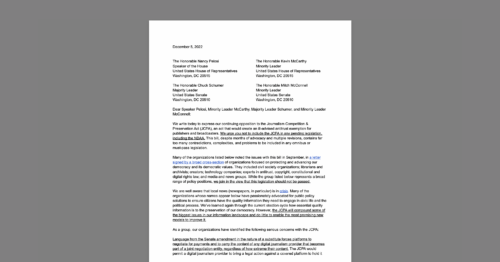
The Center for Democracy & Technology (CDT) joined a cross-section of organizations in a letter to House and Senate leaders strongly urging them not to include the Journalism Competition and Protection Act in the National Defense Authorization Act or any other must-pass legislative package. As explained in the letter, the JCPA does not protect competition or local journalism. In fact, it does the opposite. Among its many significant problems:
It would create an ill-advised and unprecedented antitrust exemption to allow already-powerful publishers and broadcasters to marshal their muscle to impose a group boycott on an online platform’s ability to share news and information with the public, unless the platform accedes to their demands.
It would force platforms to carry the content of publishers and broadcasters regardless of how extreme their content — and pay for the privilege of doing so.
It would upend fundamental copyright protections and free speech rights.
This is not a sound solution to the problems facing local journalism, and should not be passed into law.
Not All Guardrails Are Created Equal: Comparing Content Safety and Copyright Filtering
As courts and policymakers work through questions about chatbot liability, they should be wary of analogies that flatten meaningful technical differences. Copyright filtering and safety intervention share real challenges around ambiguity and evasion, but they diverge in what each control must assess, how each manifests over the course of a conversation, and how much can be verified from the outside.
Op-Ed: France’s Constitutional Council Ruling Tests the Limits of Social Media Bans
Read our analysis the legal and policy significance of the Constitutional Council’s decision on ongoing social media age restriction and age assurance debates ahead of the most-anticipated EU-wide approach on child online safety due by December 2026.
The brief explains that Section 230’s liability protections are essential to enable free expression online and they extend to the use of automated systems to engage to rank and order content as part of traditional publishing activities.