CDT Joins Groups in Filing Amicus Brief Urging Supreme Court to Review Warrantless Video Surveillance in Tuggle v. United States
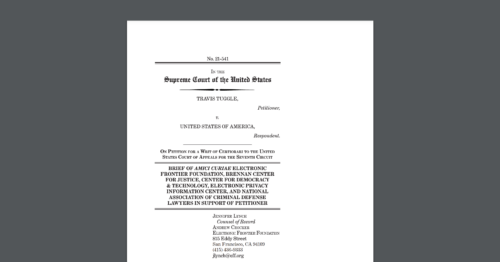
In an amicus brief filed in the U.S. Supreme Court on November 12, 2021, the Center for Democracy & Technology (CDT) joined with allied groups in urging the Court to accept review of Tuggle v. United States. The case seeks to challenge warrantless surveillance by police that lasted for a period of 18 months, using three hidden video cameras attached to utility poles and pointed at the area immediately outside Mr. Tuggle’s home. CDT filed the brief along with the Electronic Frontier Foundation (EFF), Brennan Center for Justice, Electronic Privacy Information Center (EPIC), and National Association of Criminal Defense Lawyers (NACDL).
The brief urges that the Supreme Court should hear the case because (1) as explained in Mr. Tuggle’s cert petition, there is a split of authority in the lower courts that needs to be resolved; and (2) this case involves important questions regarding whether the Fourth Amendment prohibits warrantless long-term video surveillance of areas surrounding a home, even when those areas are exposed to the public.
The brief outlines how over time, camera technology has significantly advanced while the costs of camera systems and digital storage have significantly decreased, thereby enabling highly intrusive surveillance that police departments would be unable to conduct through officers on stakeout. It also explains how the case implicates two important lines of Fourth Amendment precedent: that involving the special protection of the home and that concerning the power of modern digital technologies to invade privacy. Finally, the brief urges that the safeguards of the Fourth Amendment should not depend on whether people can afford to build a fence around their property, a rule that would disproportionately harm low-income people.
CDT-led Coalition Calls for Transparency for White House AI Framework
CDT and Americans for Responsible Innovation led a broad, bipartisan coalition of over two dozen civil society groups in calling on the White House to release its Framework for review of frontier AI models.
CDT Amicus Brief Calls on Fourth Circuit to Rein In Geofence Warrants
Earlier this year the Supreme Court ruled in Chatrie v United States that the Fourth Amendment protected all cell phone location information, which CDT lauded as a landmark decision, but sent the case back down to the Fourth Circuit to assess the propriety of the geofence warrant at issue.
CDT and Partners Post Floor Alert Opposing CA SB 1013 Automated License Plate Readers Bill
The best way to ensure that Automated License Plate Readers are not abused is to limit the retention of stored data and to keep loopholes to lawful process closed. CA SB 1013 is a step in the wrong direction, and we urge the California legislature to reject this approach.
British Public Oppose Secret Surveillance Powers and Want Strong Protections for Encrypted Communications
CDT released nationally representative polling data revealing that a the British public are broadly concerned about the security, privacy, and free speech consequences of allowing law enforcement to access encrypted communications.