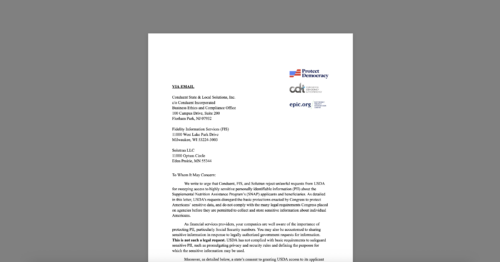
CDT Joins Call for SNAP Payment Processors to Refuse USDA Data Requests
This week, the Center for Democracy & Technology (CDT) joined Protect Democracy and the Electronic Privacy Information Center (EPIC) in calling on the private companies that process Supplemental Nutrition Assistance Program (SNAP) payments to refuse the federal government’s unprecedented, and likely illegal, request to access sensitive information about tens of millions of Americans who receive this life-saving benefit.
For over 60 years, the U.S. Department of Agriculture (USDA) has funded states to administer SNAP. In that time, the federal government has never requested access to the personal data of all program recipients, which are primarily low-income families as well as disabled or older adults. Forcing states to turn over data collected to administer a program that feeds millions of low-income, disabled, and older people for unknown purposes is an alarming data privacy threat that will create a chilling effect that prevents Americans from accessing life-saving benefits.
In this letter, we urge SNAP payment processors to stand up for privacy and refuse to facilitate this broad and dangerous attempt at government overreach.
Coalition Urges Senate Not to Let Companies Waive Financial Regulations for AI
CDT joined AI Now Institute, American Civil Liberties Union, and several organizations dedicated to tech policy, consumer protection, and civil rights in a letter to Senate leadership and the Senate Banking, Housing, and Urban Affairs Committee opposing the “AI Innovation Labs” language in Sec. 10509 of the CLARITY Act.
Potential Avenues for Redress for AI-related Harms under EU Equality and Non-Discrimination law: A Visual Explanation
In this third instalment of the series, we look at the opportunities afforded by EU equality and non-discrimination law in providing redress for AI-related harms.
The Privacy Paradox: How Government Data Has Become Less Private and Less Useful
Providing ready access to information collected and maintained by the government promotes accountability, innovation, and research, making transparency a core responsibility of serving as a steward of the public’s data. Public agencies must also safeguard sensitive information when making data publicly available.
Defending State Data: Lessons from California v. USDA
As the federal government increasingly seeks access to state administrative data, policymakers should consider not only legal authority and privacy implications, but also the practical effects on public confidence, program effectiveness, and states’ ability to fulfill their obligations to residents.