CDT Joins 140+ Organizations to Oppose Updated AI Moratorium
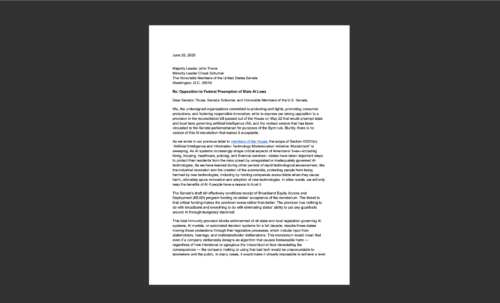
Today, CDT joined more than 140 groups to submit a letter to Senate leadership opposing the revised AI moratorium. The letter specifically highlights concerns about linking the moratorium to Broadband Equity, Access, and Deployment (BEAD) funding, arguing this approach would undermine critical protections for civil rights and consumer safety while potentially enabling widespread harm to ordinary Americans.
“Federal preemption would invalidate key state laws that protect against “high impact” AI, which is contrary to the Trump administration’s executive memo aiming to protect consumers from AI harms in employment, lending, education, and beyond. Protections for civil rights and children’s privacy, transparency in consumer-facing chatbots to prevent fraud, and other safeguards would be invalidated, even those that are uncontroversial. The resulting unfettered abuses of AI or automated decision systems could run the gamut from pocketbook harms to working families like decisions on rental prices, to serious violations of ordinary Americans’ civil rights, and even to large-scale threats like aiding in cyber attacks on critical infrastructure or the production of biological weapons.”
Coalition Urges Senate Not to Let Companies Waive Financial Regulations for AI
CDT joined AI Now Institute, American Civil Liberties Union, and several organizations dedicated to tech policy, consumer protection, and civil rights in a letter to Senate leadership and the Senate Banking, Housing, and Urban Affairs Committee opposing the “AI Innovation Labs” language in Sec. 10509 of the CLARITY Act.
As concern about risks and harms related to AI systems continue to grow, a growing chorus of policymakers, industry leaders, and advocates have called for independent AI assessments. This explainer provides an overview of recent proposals for third-party assessment in the United States, including state and federal legislation, executive actions, and industry proposals.
Having third parties assess AI systems might seem like common sense, but crafting effective policies toward this goal can be devilishly tricky. A poorly-constructed ecosystem for third-party assessment could easily fail to consider the most consequential mechanisms of risk, neglect the AI harms that most impact people, or do more to protect AI companies than people.
Not All Guardrails Are Created Equal: Comparing Content Safety and Copyright Filtering
As courts and policymakers work through questions about chatbot liability, they should be wary of analogies that flatten meaningful technical differences. Copyright filtering and safety intervention share real challenges around ambiguity and evasion, but they diverge in what each control must assess, how each manifests over the course of a conversation, and how much can be verified from the outside.