CDT Endorses and Calls on Congress to Pass the DEFIANCE Act
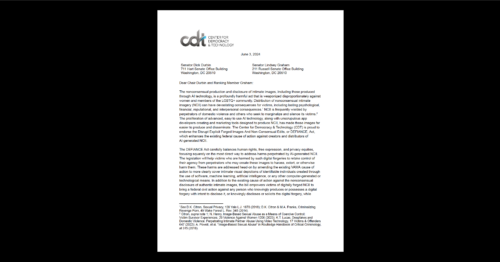
Yesterday, the Center for Democracy & Technology endorsed the Disrupt Explicit Forged Images and Non-Consensual Edits, or DEFIANCE, Act. The bipartisan, bicameral legislation clarifies the existing Violence Against Women Act federal civil cause of action for the nonconsensual sharing of intimate images to include victims of AI-generated images.
The nonconsensual production and disclosure of intimate images, including those produced through AI technology, is a profoundly harmful act that is weaponized disproportionately against women and members of the LGBTQ+ community. The proliferation of advanced, easy to use AI technology has made AI-facilitated NCII far easier to produce and disseminate. NCII can cause acute and potentially irreversible emotional, financial, reputational, and interpersonal harm. Often created and shared with the intention of humiliating and marginalizing its victims, NCII can have a chilling effect on the speech of those depicted, silencing their voices and reducing the prominence of their perspective within the marketplace of ideas.
Carefully drafted to survive legal scrutiny, the DEFIANCE Act focuses squarely on the unique harms posed by AI-generated NCII while minimally impacting valuable speech. The DEFIANCE Act would provide meaningful clarification and enhancements to existing law for those harmed by NCII, however it’s created, while including important and necessary protections for free expression. CDT urges Congress to pass the DEFIANCE Act immediately.
On September 15, 2026, the Center for Democracy & Technology and Electronic Frontier Foundation filed an amicus brief along with the Wikimedia Foundation in Meta Platforms v. Bonta, challenging California’s SB 976.
Not All Guardrails Are Created Equal: Comparing Content Safety and Copyright Filtering
As courts and policymakers work through questions about chatbot liability, they should be wary of analogies that flatten meaningful technical differences. Copyright filtering and safety intervention share real challenges around ambiguity and evasion, but they diverge in what each control must assess, how each manifests over the course of a conversation, and how much can be verified from the outside.
Op-Ed: France’s Constitutional Council Ruling Tests the Limits of Social Media Bans
Read our analysis the legal and policy significance of the Constitutional Council’s decision on ongoing social media age restriction and age assurance debates ahead of the most-anticipated EU-wide approach on child online safety due by December 2026.
The brief explains that Section 230’s liability protections are essential to enable free expression online and they extend to the use of automated systems to engage to rank and order content as part of traditional publishing activities.