CDT Defends Encryption Against Broadside Attack from Nevada AG
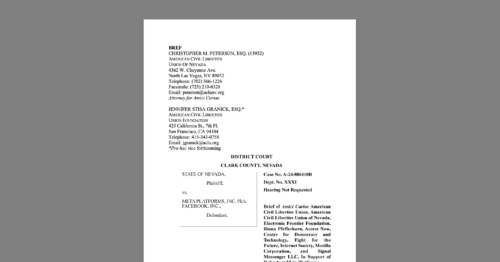
Late last night, the Center for Democracy & Technology (CDT) joined other organizations in urging a Nevada district court to reject the effort of the Nevada attorney general to prevent people in Nevada from using an end-to-end encrypted messaging service by if they are under the age of 18. We signed onto a brief, led by ACLU, EFF and research scholar Riana Pfefferkorn, urging the Court to reject Nevada’s motion for a preliminary injunction that would bar Meta from offering encrypted messaging services to youth in Nevada. Nevada’s assault on encryption is extraordinary and without precedent: it is suing a tech company to deny an entire class of users the ability to communicate securely using its encrypted messaging app.
We pointed out that end-to-end encryption is essential to secure communications on the inherently insecure Internet, and that it has been available by default for years from other messaging services, such as Signal and Apple’s iMessage. Meta began to roll out E2EE by default on Messenger late last year, and had offered E2EE since 2016 to those who opted in.
We also explained that denying children the opportunity to use E2EE encrypted messaging services does not protect them; it exposes them to danger. When a teenager confides with their parents and their friends sensitive information about their health, their fears, their activities, and who they are with and where they are going, the communications containing that information must be secured by encryption to promote child safety.
CDT has long supported encryption, and is a founding member of the Global Encryption Coalition, which counts among its members other amici including the lead drafters, the Internet Society, Mozilla, Signal, Access Now, and Fight for the Future.
CDT-led Coalition Calls for Transparency for White House AI Framework
CDT and Americans for Responsible Innovation led a broad, bipartisan coalition of over two dozen civil society groups in calling on the White House to release its Framework for review of frontier AI models.
CDT Amicus Brief Calls on Fourth Circuit to Rein In Geofence Warrants
Earlier this year the Supreme Court ruled in Chatrie v United States that the Fourth Amendment protected all cell phone location information, which CDT lauded as a landmark decision, but sent the case back down to the Fourth Circuit to assess the propriety of the geofence warrant at issue.
CDT and Partners Post Floor Alert Opposing CA SB 1013 Automated License Plate Readers Bill
The best way to ensure that Automated License Plate Readers are not abused is to limit the retention of stored data and to keep loopholes to lawful process closed. CA SB 1013 is a step in the wrong direction, and we urge the California legislature to reject this approach.
British Public Oppose Secret Surveillance Powers and Want Strong Protections for Encrypted Communications
CDT released nationally representative polling data revealing that a the British public are broadly concerned about the security, privacy, and free speech consequences of allowing law enforcement to access encrypted communications.